
I wrote my last blog as Director of Conservation Optimism a year ago, in the run-up to the 2024 Conservation Optimism Summit. With the Summit in full view, we were very focussed on Conservation Optimism’s mission to Empower, Enable and Embrace conservationists around the world. Too many of our colleagues and friends, and many brave people who we’ve never met and probably never will, feel weighed down, anxious, often overwhelmed by the constant negativity of the discussion around the climate and biodiversity crises. Thanks to the hard work of many people, last year’s Summit was a great success; over 300 people attended either in Oxford or online and many said that it made a significant difference to them and their work.

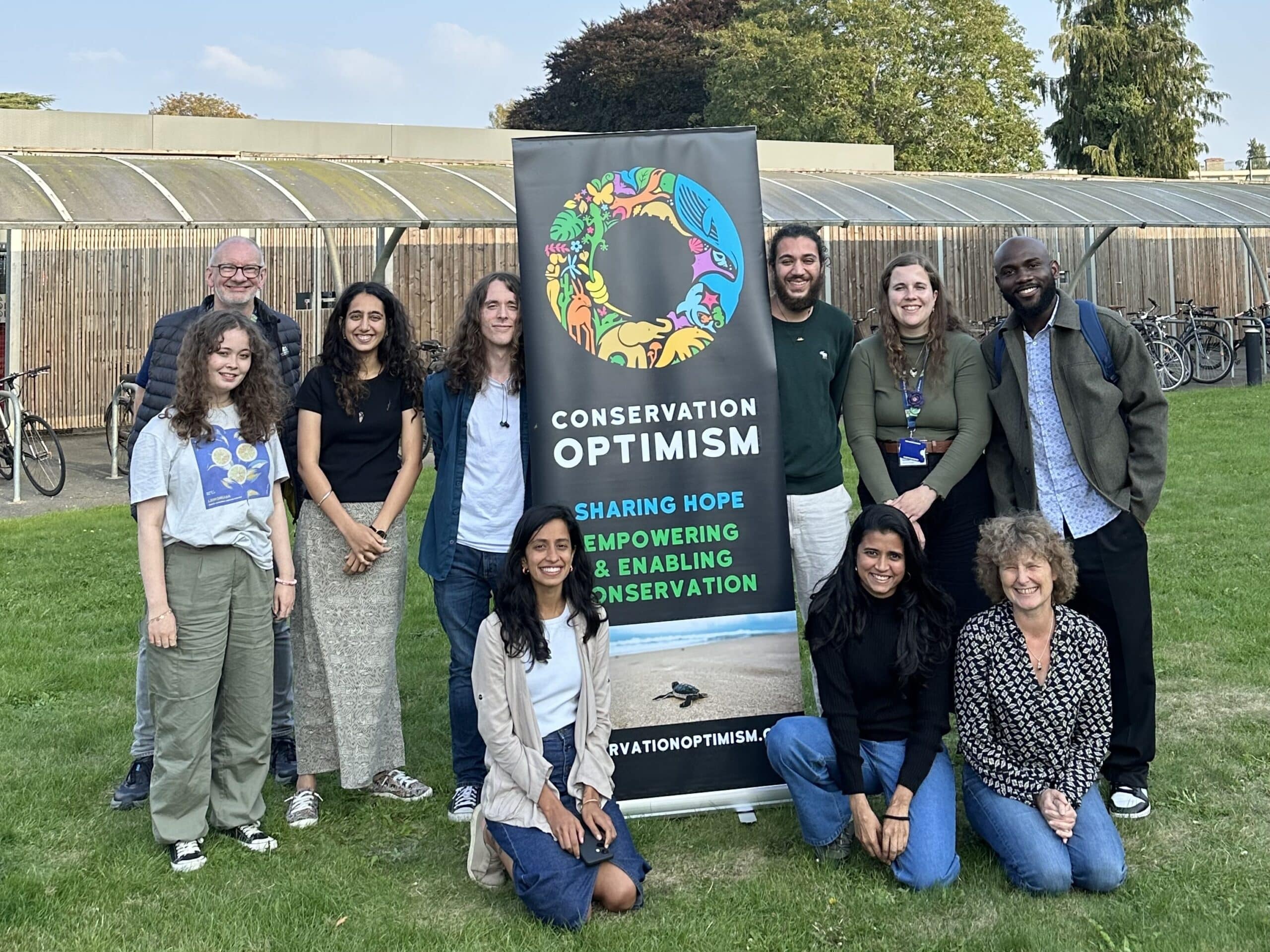
Some of the CO team at the 2024 Summit in Oxford, UK
But summits take an enormous amount of work; most of the day-to-day work of Conservation Optimism is carried out on a smaller scale and, given our global scope, online. Every week we publish our Seven Stories of Optimism, sharing recent successes in the world of conservation. We regularly commission and publish blogs from organisations and people around the world who have stories of conservation learning, success, and inspiration to share. And every couple of months we host a webinar by one of the members of our ConservationNOW network (a community of organisations that shares our belief in the power and necessity of hope) in which they spend an hour sharing the lessons they have learned and passing on their skills.


Social media posts promoting some of our 7 Stories Roundups
All this work contributes to our mission to rebalance the conversation (what social scientists call ‘the discourse’) around the great environmental challenges of our time. We do not seek to challenge the existing discourse – we are indeed in a state of ‘crisis’ and ‘emergency’. There are 8.2 billion people on the planet and the majority of them are overconsuming. Every climate model that shows climate change staying under the desired 1.5°C limit requires greenhouse gas emissions to peak by this year (2025) and then decrease very rapidly; we see no sign of that happening.
Here in the UK, the Government has signed up to the Kunming-Montreal 30×30 targets, yet most estimates of the percentage of land effectively protected for nature in England are under 3%. The global populations of Javan and Sumatran rhinos may both be fewer than 50 animals; there may be fewer than ten vaquitas left in the Gulf of California [vaquita: ‘little cow’ – a critically endangered species of porpoise]. We are under no illusions about the scale of the problem.
And yet there is another side to this conversation. Around the world, committed people devote their lives to protecting the natural world, and many of their efforts succeed. Last year a meta-analysis in which the University of Oxford was involved showed that two-thirds of conservation projects have at least some positive impact. Every week, new stories of conservation success are reported. One of Conservation Optimism’s primary roles is to share these stories, not to supplant the discourse around ‘crisis’, but to counterbalance it: to reach out to people everywhere who are working for a more sustainable and healthy future, and to share the news of real and sorely needed hope.

Professor Julia Jones of Bangor University giving the opening keynote at the 2024 Conservation Optimism Summit
Our work is to influence people, to give them hope, and thereby agency. And through that work we have developed understanding, even expertise, in the use of communication and language to influence how people feel and act. Of course, this knowledge is not new; every great orator in human history has known how to read and move an audience – ‘Friends, Romans, Countrymen’; ‘I have a dream’; ‘Be the change that you wish to see in the world’. But now, with greater scientific understanding of how the human brain works and processes language, we can understand these communication tools and their potential through new lenses.
And so, we also regularly attend conferences, workshops and meetings with other organisations, passing on our own learning and skills in the use of communication as a conservation tool. That tool is invaluable, not only for giving hope and inspiration to our fellow conservationists, but also for inspiring people to understand the value of nature to their own lives and to protect the natural world as a resource that is valuable to them and their families.
In the next part of this blog I will share some of these powerful communication tools.
