Wondering what went right this week in the conservation world? We’ve got you covered with our Conservation Optimism Round-Up! We are collating stories of optimism from around the globe so that you never miss your dose of weekly motivation. (Featured image credit: Bombus lapidarius drone by Ivar Leidus via Wikimedia Commons, CC BY-SA 4.0)

1. Kenya court upholds cancellation of 1,050 MW coal plant license
Plans for a coal-fired power plant in the Lamu archipelago have been effectively frozen, as Kenya’s Environment and Land Court upheld a 2019 ruling revoking the environmental license for the project. The decision is a victory for local and regional groups that have campaigned against its construction since plans were released in 2016, and Mongabay reports that this seems to reflect a broad shift away from coal in East Africa.
Omar Elmawi, a deCOALonize campaign lawyer and board member, told Mongabay this “marks the end of an almost decade-long struggle. The people of Lamu stood firm against the coal giant Amu Power, and NEMA, who sought to impose a coal plant on this ecologically sensitive and culturally rich archipelago.”
“This victory is a powerful reminder that when communities speak with one voice, they can move mountains.”
Kenya’s Environment and Land Court has upheld a 2019 ruling that revoked the environmental license for the proposed 1,050-megawatt Lamu coal-fired power plant, effectively halting the controversial project.
— Mongabay (@mongabay.com) November 10, 2025 at 1:10 AM
[image or embed]
2. Britain’s red-tailed bumblebees may have an unlikely saviour in solar farms
Bumblebees are in decline across the UK, but as solar farms become more common, sensitive management may provide a way to boost their numbers. New research has shown planting solar farms with hedges and flowers more than doubles the bumblebee population compared to site that were turfed, reported by the Guardian.
Bumblebees are impressive pollinators, but are threatened by intensive farming. This research suggests that a network of well-planted solar farms could provide refuges for bumblebees and be an effective tool in future bumblebee conservation, especially if placed strategically to connect existing habitats.
Britain’s red-tailed bumblebees may have an unlikely saviour in solar farms
— Guardian Environment (@environment.theguardian.com) November 5, 2025 at 6:03 AM
[image or embed]
3. Little penguins re-establish breeding grounds on NSW far south coast
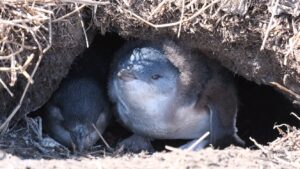
Little penguins have been spotted breeding in Eden on the New South Wales coast, reports ABC News, with birds returning to their old breeding grounds after 40 years. Eden is one of two sites where penguins are present in mainland Australia, with their return credited to an audio system that broadcasts mating sounds at the site.
“It’s really exciting, it’s the beginning of a colony, but it’s still got that fragility to it until we can protect them properly.” While conservationists celebrated the penguins reestablishing the colony, there are concerns about the penguins breeding too close to a busy port, and about managing predators. With eight pairs now breeding in the bay, researchers are cautiously optimistic.
“This is something very precious that may grow, but we’ve got to give it that opportunity.”
4. Back from the brink: UK red kites aid Spanish cousins
Red kites are now thriving in the UK after near-extinction 40 years ago, thanks to massively successful reintroduction programmes. In Spain, conservationists have now released British-born red kites in a four-year project to boost the threatened population there. The relocation project in Extremadura has so far seen three mating pairs that have produced two surviving chicks, with hopes for these numbers to multiply as more released kites reach maturity.
“There are still huge areas of southern Spain where the red kite was common three decades ago and is now almost extinct,” says Alfonso Godino, the project manager. “So the next step is how we can apply this experience to other areas of Spain.”
Back from the brink: UK red kites aid Spanish cousins https://t.co/TqllTswrbz
— BBC News (UK) (@BBCNews) November 10, 2025
5. In Cape Town, local communities are advancing urban restoration
Cape Town has launched a wide-ranging restoration drive aiming to improve the health of its urban ecosystems, bringing nature back to its shores and waterways. These efforts have caught the attention of the UN Environment Programme, who have selected it as role model for other municipalities and regions looking to restore urban ecosystems around the world.
The city’s initiatives range from launching community-named weed harvesters to restore shallow lakes popular with sailors, birdwatchers and picknickers, to involving ‘friends’ groups keen to restore local areas by removing invasive plant species, restoring indigenous vegetation, carrying out wildlife surveys and maintaining trails.
“City leaders can prioritize restoration when residents feel how it will improve their lives as well as the health of the planet,” said Mirey Atallah, Chief of the Adaptation and Resilience Branch in UNEP’s Climate Change Division. “By engaging people at every step of their restoration projects, cities like Cape Town turn communities into advocates for the resilient cities that we all need, now and in the future.”
Across the world, cities are turning urban spaces into food gardens, teaching resilience & cutting food waste. Explore how cities are building a sustainable future: https://www.unep.org/news-and-stories/story/cape-town-local-communities-are-advancing-urban-restoration
— UN Environment Programme (@unep.org) November 9, 2025 at 1:00 PM
[image or embed]
6. Rare orchid brought back from brink of extinction
After a long conservation campaign, the Fen Orchid Liparis loeselii is no longer considered under threat in the UK. The orchid now has a population of over 10,000 individuals across 10 sites, bouncing back from near-extinction in 2008.
“As we face the enormous challenges of climate and biodiversity loss, this provides a moment of genuine hope for the future and is a testament to what dedicated partnership conservation work delivered consistently over many decades can deliver,” said Tim Pankhurt, former conservation manager at Plantlife.
“The challenge now is to ensure that the Fen Orchid continues to thrive in its current locations and, either naturally or with a helping hand, flourish in former sites and new places within its native range in the coming years.”
A rare wild orchid has been brought back from the brink of extinction by the work of dedicated conservationists.
— BBC Cambridgeshire (@BBCCambs) November 10, 2025
Read more here ➡️ https://t.co/jRWO94p80y
(📷 Cambridge University Botanic Garden) pic.twitter.com/0s4UmKub15
7. Healthy rivers, healthy people: A Brazil project links human & ecosystem well-being
Brazilian public health doctor Apolo Heringer founded the Manuelzão Project in 1997, based on the idea that there is no human health without healthy ecosystems. They aim to bring fish back to the Velhas River and revitalise the river basin, in turn supporting local ecosystems and the 3.7 million people living in the region.
After the local government adopted Manuelzão Project plans, sewage treatment plants were built along the river — and by 2010 the fish had started returning. “The fauna changed as water quality improved. So fish that used to only be found farther downstream in the basin … began to appear closer to Belo Horizonte.”
“The Manuelzão Project is not a project to clean up the river, clean the river, remove pollution,” Heringer says. “The Manuelzão Project is a project to change the mentality of the Earth.” Read more about how the Manuelzão Project is changing the narrative around public health in this article by Mongabay.
A night fishing trip 30 years ago showed Brazilian public health doctor Apolo Heringer the meaning of health: a clean river full of fish. This idea inspired the Manuelzão Project to restore Brazil's Velhas River Basin. After sewage treatment plants began operating in the area, fish began to return.
— Mongabay (@mongabay.com) November 10, 2025 at 12:17 PM
[image or embed]
Have a story to share for our weekly round-up? Use #ConservationOptimism on Twitter, Facebook, LinkedIn and Instagram!