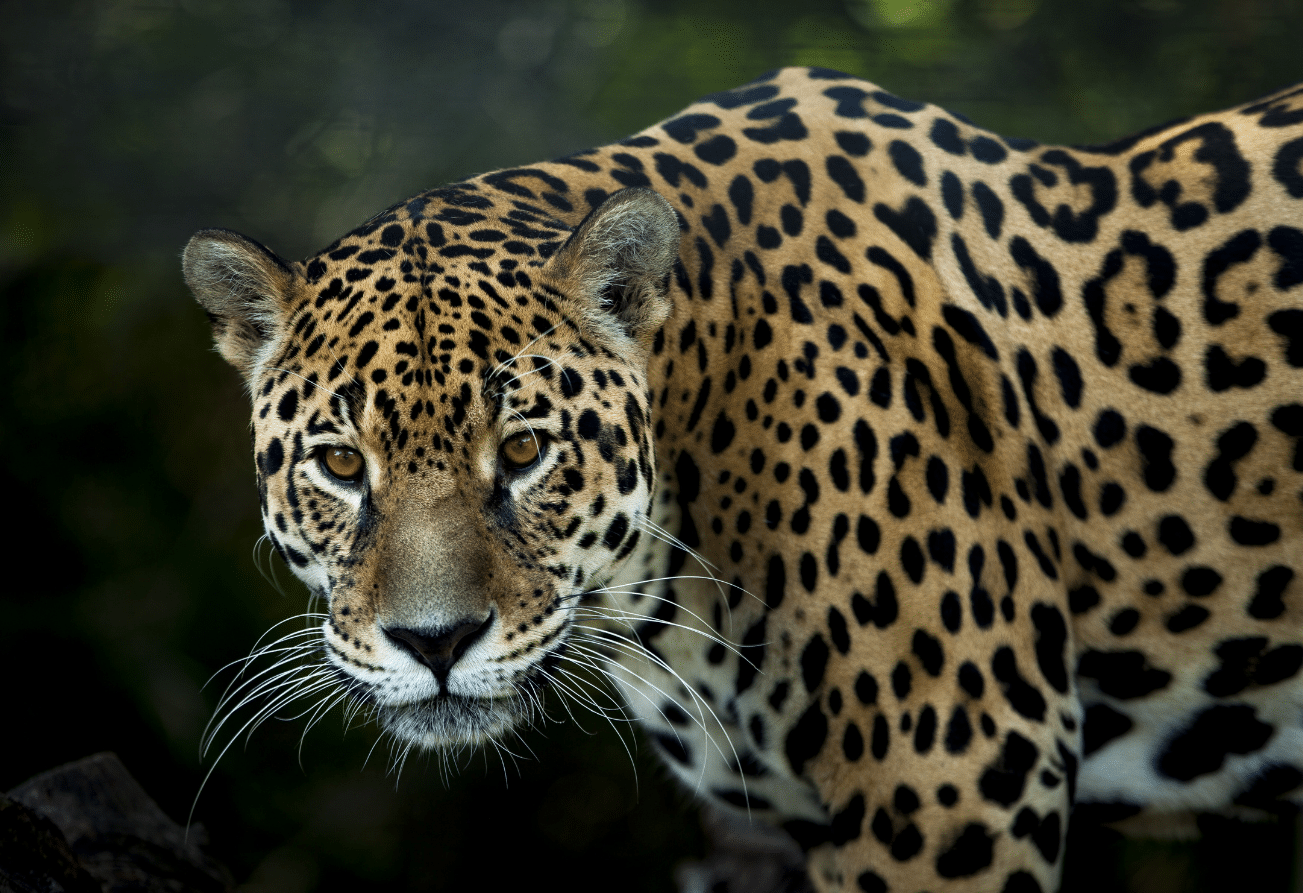
Wondering what went right this week in the conservation world? We’ve got you covered with our Conservation Optimism Round-Up! We are collating stories of optimism from around the globe so that you never miss your dose of weekly motivation. (Featured image credit: Jaguar in Nature, by Nickbar from pixabay accessed via Canva)
1. Conservation trusts purchase threatened area in South Africa’s Western Cape province.
Three conservation trusts have together purchased an area of a severely threatened vegetation type found in the Overberg region of South Africa’s Western Cape province. Known as the renosterveld, this unique habitat characterized by shrubs and grasses is also a breeding ground for endangered black harriers.
The Overberg Renosterveld Trust (ORT) partnered with the U.K.-based World Land Trust and the Mapula Trust to buy the 270-hectare property called Goereesoe. The site is part of the Eastern Rûens Shale Renosterveld, an ecosystem considered to be critically endangered. The renosterveld used to cover a large part of the Overberg region, but now only 5% remains, due to land conversion for agriculture, ORT said.
“This is a significant win for renosterveld and the Black Harrier,” Odette Curtis-Scott, CEO of the ORT, said in the release. “By securing this land, we are protecting critical habitat and species whose futures are teetering on a knife edge.”
“Protecting this site means safeguarding one of the most threatened ecosystems on Earth, and the species that depend on it” #rewilding #conservationoptimismhttps://t.co/Gql01JstNA
— Citizen Zoo (@CitizenZoo) September 1, 2025
2. Californian kelp forest saved by collaboration of non-profit with scientists, citizen volunteers and commercial fishers
Fast-growing kelp ecosystems are known as the “sequoias of the sea”: they store large amounts of carbon, create habitat for more than 800 marine species and blunt the powerful force of storm waves. Due to multiple pressures, the ecosystem became unbalanced and at risk of disappearing, with an overabundance of with endemic purple urchins eating kelp and scratching the reef bed so much that kelp spores circulating couldn’t grab a foothold.
The Bay Foundation is a non-profit dedicated to restoring Santa Monica Bay and its coastal waters, and started working in these waters in 2012. They did multiple tests to determine the optimal amount of urchins per square meter: two. Meanwhile, some areas of the barrens had 70-80 urchins per meter. Divers in the Santa Monica Bay have spent 15,575 hours underwater over the past 13 years, venturing down out and smashing urchins week after week, clearing the plots. The effort has been successful, smashing 5.8 million purple urchins and clearing 80.7 acres (32.7 hectares, the size of 61 football fields), and allowing the kelp to return.
‘The forgotten forest’: how smashing 5.6m urchins saved a California kelp paradise
— The Guardian (@theguardian.com) August 31, 2025 at 5:33 PM
[image or embed]
3. After 160 years, an old drawing leads scientists to a long-lost Sri Lanka orchid
After 160 years, scientists in Sri Lanka have rediscovered Vanda thwaitesii, a delicate tropical Asian orchid, by referring to scientific drawings to make the connection. “Many assumed it had vanished from the Earth, so we were delighted to find it alive after all this time,” says Bhathiya Gopallawa, a Ph.D. candidate at Sri Lanka’s University of Peradeniya, who co-authored the paper announcing the rediscovery.
The return of V. thwaitesii is also a testament to citizen science, a trait of many recent floral rediscoveries and finding of rare plants. Gopallawa and colleagues had established a Facebook group, Medicinal Plant Identification, to connect botanists with plant enthusiasts across Sri Lanka. In 2020, he posted a painting of the orchid.
One member, Pradeep Kodithuwakku, recognized the flower. Years earlier, he had found an orchid that had fallen near a stream in Rangala. Believing it was valuable in some way, he took it home and cared for it. When it began flowering a few years later, he took a photo and later shared it with Gopallawa, who was struck by its resemblance to the long-lost orchid. Together with field botanist Himesh Jayasinghe, he visited Kodithuwakku’s home to confirm the discovery.
After 160 years, scientists in Sri Lanka have rediscovered Vanda thwaitesii, a delicate tropical Asian orchid, by referring to scientific drawings to make the connection. Conservationists caution that this rediscovery does not mean recovery and call for urgent measures to safeguard floral heritage.
— Mongabay (@mongabay.com) August 30, 2025 at 11:53 AM
[image or embed]
4. 75 water voles released into Lake District national park, UK
Around 75 water voles were released in the Ennerdale Valley in the Lake District, UK, on Tuesday by Forestry England and West Cumbria Rivers Trust after three years of preparation.
Water voles were once widespread across UK waterways but have suffered a dramatic population decline since the 1970s due to habitat loss and predation by the American mink, and are now on the red endangered list of British mammals.
A key part of the project is to keep the Ennerdale Valley free from the predator and a network of traps were established ahead of their release. Hayley Dauben, species introduction project officer at Forestry England, said they were “confident” the area was an “excellent habitat” for the creatures, “providing a good food supply and higher chance of evading predators”.
'Water voles have been released into a valley in a national park in the hope of rebuilding the population.' #rewilding #conservationoptimismhttps://t.co/kdW3Nt5SQ2
— Citizen Zoo (@CitizenZoo) August 27, 2025
5. China’s finless porpoise population recovering
Chinese scientists are in a battle to save one of the last large animal species living in the Yangtze River: the finless river porpoise. “It’s the only top-level predator left in the river,” Professor Wang Xi explains. “They are rare and their numbers reflect the health of the entire system’s ecology.”
Nearly five years ago, a full 10-year-ban finally came into force, carrying potential prison time for those caught fishing right along the Yangtze, as well as adjacent lakes and tributaries. Research published in the Bulletin of the Chinese Academy of Sciences, records a drastic increase in fish numbers since the ban came into effect in 2021. Additionally, thousands of factories which produce chemicals into the Yangtze have been shut down or relocated over the past decade, in a move that is said to have significantly improved the river’s water quality.
In the 1990s there were 3,300 finless porpoises in the wild. By 2006 this had halved. Then the fishing bans came in, the factories were moved and the decline stopped. Not only that, but over the last five years of records, porpoise numbers have gone up by nearly a quarter. We’re saving the finless porpoise to save the Yangtze River,” says Wang Ding. “If the porpoises are doing fine, if their numbers are increasing, this means the ecological health of the whole river is also improving.”
"If the porpoises are doing fine, if their numbers are increasing, this means the ecological health of the whole river is also improving." #rewilding #conservationoptimismhttps://t.co/qUy73843MD
— Citizen Zoo (@CitizenZoo) August 26, 2025
6. Philippines Declares New Marine Protected Area in Biodiversity-Rich Siquijor
Philippines has officially designated Bitaug Marine Protected Area (MPA), now the largest MPA in Siquijor and covering 149.46 hectares (about 370 acres, or 1.5 km2) of vibrant coastal oceans. Bitaug is home to climate-resilient coral reefs, seagrass meadows, commercially important fish stocks, and vibrant populations of sea turtles and sharks. Notably, it includes explicit rules prohibiting the catch of sharks and rays (unless for research purposes) – making Bitaug part of a growing roster of MPAs around the world with targeted protections for these vulnerable species.
The MPA designation reflects years of participatory planning and consultations, community leadership, and support from a huge variety of NGO partners. “This momentous event is not just the launching or inauguration of a protected site, it is a powerful step forward in our collective journey toward environmental sustainability, coastal resilience, and community empowerment, “ says Ms. Peachy Baquilta, Assistant Extension Director of Siquijor State College.
#OceanOptimism newsroom.wcs.org/News-Release...
— Nancy Knowlton (@nancyknowlton.bsky.social) August 28, 2025 at 7:04 PM
[image or embed]
7. Mexico’s jaguar numbers up 30% in conservation drive
In 2010, Gerardo Ceballos and a group of other researchers from the National Alliance for Jaguar Conservation carried out the country’s first census of jaguars in Mexico, finding 4,100 individuals.
Now, a new census has found 5326 jaguars in Mexico, a 30% increase compared with 2010. The census took over 90 days across 15 states, using 920 motion-capture cameras and involving nearly 50 researchers as well as local community leaders. Researchers looked at an area of 414,000 hectares, making it the largest census for any mammal in Mexico.
Ceballos credits three main factors for the population increase: maintaining natural protected areas where jaguars can roam freely, reducing the conflict between cattle ranchers and jaguars, and a publicity campaign that has put the jaguar on the map.
“The fact that the country has managed to maintain and increase its population over the last 14 years is extraordinary,” Ceballos said. “For me it’s great news for the country. Mexico and the world need good news.”
‘We’re winning a battle’: Mexico’s jaguar numbers up 30% in conservation drive
— The Guardian (@theguardian.com) September 1, 2025 at 1:38 PM
[image or embed]
Have a story to share for our weekly round-up? Use #ConservationOptimism on Twitter, Facebook, LinkedIn and Instagram!