
After a brief hiatus, we are back, bringing in weekly doses of optimism in the conservation world from across the globe!
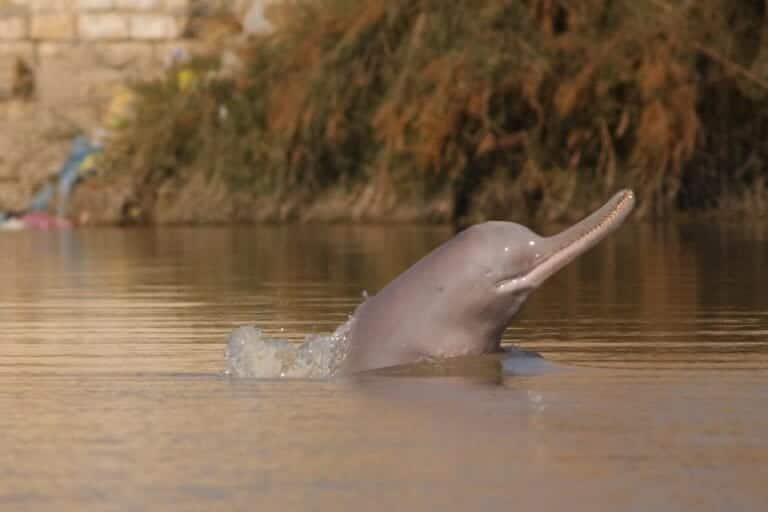
(Featured image credit: The Indus river freshwater dolphin from Sindh, Pakistan. Wikimedia Commons)

1. First – a story of hope for a better future for birds through Margaret Atwood!
Best-selling novelist Margaret Atwood has donated C$1m to establish the Graeme Gibson Chair in avian biology at Ontario’s Western University, in honour of her late partner, Graeme Gibson, and his love of birds. The donation contributes to the university’s leading research efforts on avian biology and ecology in a transforming environment.
‘Hope is a built-in characteristic’: Margaret Atwood on birds, conservation and optimism for the future
— Guardian Environment (@environment.theguardian.com) September 25, 2026 at 9:03 PM
[image or embed]
2. Collaborative conservation action for Niokolo-Koba National Park
Encompassing swathes of savannahs, forests, rivers, and wetlands, the Niokolo-Koba National Park, along the banks of the Gambia River, is recovering through efforts by Senegal, IUCN Members, and IUCN Commission Experts.
This blossoming story of optimism has it all – building local capacity to conduct comprehensive surveys of wildlife and habitat conditions, landscape-level restoration efforts aimed at reconciling biodiversity conservation, governance, and the development of green economies, a new IUCN-led initiative designed to support biodiversity conservation, ecosystem restoration and community resilience across the landscape, and species-specific conservation efforts!
3. Record-breaking chough numbers around the Cornish coastline.
RSPB England said 161 choughs were counted in Cornwall, 32 more than the 129 recorded in 2025.
“Long may the successful return of this iconic Cornish bird delight myself and others.” – Peter Hall, a National Trust chough monitoring volunteer.
‘Living proof damaged landscapes can recover’: exploring a vast restored forest in southern Sweden
— Guardian Environment (@environment.theguardian.com) 13 August 2026 at 08:02
[image or embed]
4. Skylarks and sandwich terns among new birdies on reserve created from ‘boring old golf course
National Trust has transformed Sandilands in Lincolnshire into a nature reserve with wetlands and wading pools.
From Madagascar’s golden-crowned sifaka to Mexico’s Charco Azul pupfish, 100 species facing extinction are getting a $200 million lifeline. The Phoenix Species Project will fund targeted conservation efforts across 30 countries to bring species back from the brink. Learn more! 👇️
— Mongabay (@mongabay.com) 15 August 2026 at 16:40
[image or embed]
5. Pakistan expands protected habitat for Indus River dolphin as recovery offers hope
A 2025 abundance study reveals the endangered Indus River dolphin metapopulation has rebounded to an estimated 1,987 individuals, marking a 19.4% increase between 2011 and 2017.
Pakistan’s government has officially created the Punjnad Indus River Dolphin Sanctuary in June 2026, safeguarding nearly 200 kilometers (123 miles) of the river in Punjab.
“The sanctuary has the potential to make a substantial difference in addressing threats such as fisheries interactions because it provides a stronger basis for regulating activities, monitoring threats and coordinating conservation interventions.”
Pakistan's endangered Indus River dolphin population has grown to nearly 2,000 individuals, prompting the creation of a new 400-km protected corridor. Safeguarding the species long-term will require modified barrage operations and community-led sustainable fishing. Fellow Muhammad Talal reports.
— Mongabay (@mongabay.com) September 25, 2026 at 11:10 PM
[image or embed]
6. Lost no more – Ghana cuckooshrike reappears in Upper Guinean rainforest
In June, a team of researchers working in Côte d’Ivoire’s Taï National Park spotted a Ghana cuckooshrike, a bird that hadn’t been seen in 13 years.
The ‘rediscovery’ shows the value of conserving places like Taï, where mining and illegal hunting also pose threats.
Unseen for 13 years, the rare Ghana cuckooshrike has re-emerged in Côte d’Ivoire’s Taï National Park. Enabled by local collaboration and the Search for Lost Birds project, the discovery underscores the need to safeguard West Africa's remaining intact forest sanctuaries. John Cannon reports.
— Mongabay (@mongabay.com) September 25, 2026 at 1:14 AM
[image or embed]
7. A discovery, once again! A rare slow loris may have a much larger population in China than scientists thought
A recent study documented 98 northern pygmy slow lorises living in the wild in Guangxi, China, roughly doubling the country’s known population of the endangered species.
“A lot of these nocturnal animals — they’re so little known in the wild, they’re so little researched, that when you actually do go look for them and you find them, that’s incredible” – Anna Nekaris, a professor of ecology, conservation and environment at Anglia Ruskin University in the U.K. and founder of the Little Fireface Project
Long thought to live almost exclusively in Vietnam and Laos, the endangered northern pygmy slow loris has a much larger wild population in China than previously known. Despite the promising finding in Guangxi, the species faces ongoing threats from habitat loss and hunting. By Matthew Burkhart.
— Mongabay (@mongabay.com) September 24, 2026 at 10:10 AM
[image or embed]
Have a story to share for our weekly round-up? Use #ConservationOptimism on Twitter, Facebook, LinkedIn and Instagram!
