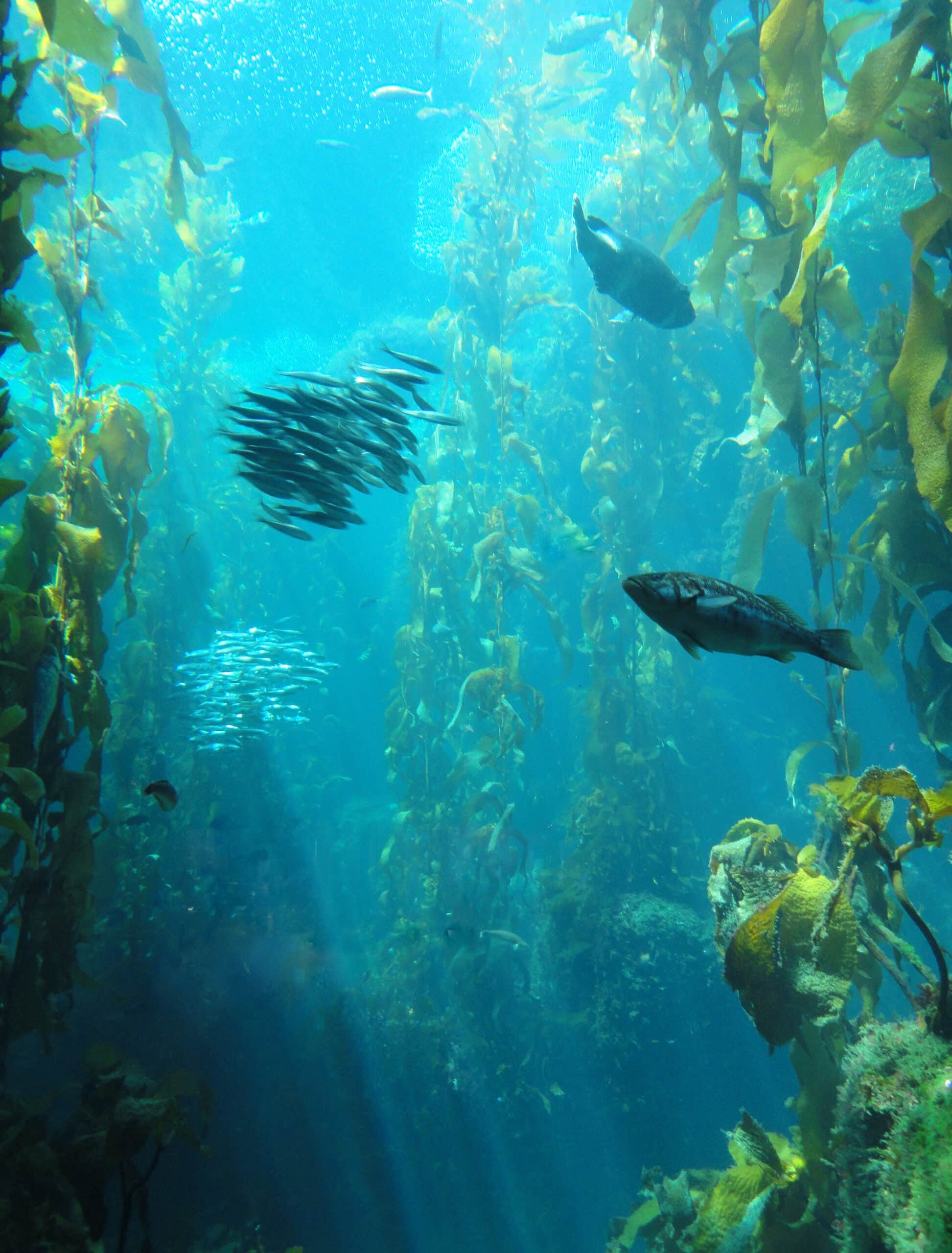
Wondering what went right this week in the conservation world? We’ve got you covered with our Conservation Optimism Round-Up! We are collating stories of optimism from around the globe so that you never miss your dose of weekly motivation. (Featured image credit: kelp forest via Wikimedia Commons)

1. Sniffer dogs may have rediscovered a lost population of Sumatran rhinos
Sumatran rhinos were thought to be extinct in southern Sumatra, with years of unsuccessful searches in Way Kambas National Park. However, a new team of sniffer dogs recently located what they believe to be Sumatran rhino dung after just two days of searching.
“I was nothing short of thrilled,” the executive director of Working Dogs for Conservation Pete Coppolillo tells Mongabay. “With fewer than 50 [Sumatran rhinos] in the entire global population, even a single individual is a big deal.” Tests to confirm that it was deposited by a Sumatran rhino are ongoing, with the first complete and two remaining, but “conservationists are cautiously optimistic.”
“I’ve never been happier to be wrong about something in my life if I indeed am wrong. There are clearly some very reclusive rhinos hanging out. My hope is that there are more of those rhinos in more places than we know of.”
#conservationoptimism Experts thought the critically endangered Sumatran rhino population in southern Sumatra's Way Kambas National Park had gone extinct But now Working Dogs for Conservation has detected several signs of them in the park, @jeremyhance.bsky.social reports for @mongabay.com
— Erik Hoffner (@erikhoffner.bsky.social) August 18, 2025 at 6:52 PM
[image or embed]
2. Scientists make ‘superfood’ that could save honeybees
Research 15 years in the making has developed a new food that “provides all the nutrients bees need to survive, meaning we can continue to feed them even when there’s not enough pollen,” reports an article in BBC News.
Bees normally eat pollen and nectar, but when pollen is scarce the food provided by beekeepers lacks important nutrients called sterols, which are difficult to manufacture. The new method uses genetically modified yeast to produce the six sterols that bees need for development. Colonies fed with the food had up to 15 times more baby bees that made it to adulthood.
The article reports that “when the bees have a complete nutrition they should be healthier and less susceptible to disease,” and “the food would be particularly useful during summers like this one when flowering plants appear to have stopped producing early.”
Scientists make 'superfood' that could save honeybees https://t.co/F91pLVYxkC
— BBC News (UK) (@BBCNews) August 20, 2025
3. Scimitar-Horned Oryx Day: A Testament to Conservation in Action
On the 16th August, we celebrated Scimitar-Horned Oryx Day and the species’ extraordinary recovery. Previously listed as Extinct in the Wild in the 1990s, reintroduced populations have been established in four countries across northern Africa, and the oryx was downlisted as Endangered by the IUCN in 2023.
Their successful reintroduction is a result of continued management and collaboration by local governments and their international partners. A blog by WAZA highlights the importance of zoos in providing breeding animals for these ambitious conservation programmes.
“This is a powerful indicator of successful conservation. The scimitar horned oryx is now recognised not only as a species of concern but as a clear example of effective international cooperation in species recovery.”
⚔️🦌 #ScimitarHornedOryx Day is a global celebration! 🌍
— BIAZA (@BIAZA) August 12, 2025
To highlight its importance, @WAZAglobal outlines the role of zoos in global conservation, from advocacy and funding to maintaining genetic diversity 👇https://t.co/tcZ4bmv5RC#SHOday #SHOtime pic.twitter.com/T8YyDEjQJb
4. Community efforts yield new marine protected area in the Philippines
“The Philippines has officially designated a new marine protected area after an 18-year campaign by local communities, fisher associations, civil society organizations and government agencies, the Wildlife Conservation Society announced Aug. 13.”
The Bitaug Marine Protected Area (MPA) protects 150 ha of highly biodiverse coastal waters, home to corals, seagrass, and mangrove forests that act as breeding grounds for fish. The Bitaug Fisherfolk Association has campaigned for the protected area since 2007 with widespread support from the local community, and will now co-manage the MPA with the local government. “Hopefully, in time, we will truly take charge of managing and caring for our MPA. This is the beginning of what we’ve been dreaming of for almost eighteen years,” Othello Manos, president of BitFA, said in the WCS statement.”
“We are hoping that within two years this MPA will generate income for us. We worked hard to have this marine sanctuary because we saw the benefits it brought to other towns,” Manos told PIA.” Read more about their journey to establishing the protected area and its benefits to the community and environment here.
The Philippines has officially designated a new marine protected area after an 18-year campaign by local communities, fisher associations, civil society organizations and government agencies, the Wildlife Conservation Society announced Aug. 13.
— Mongabay (@mongabay.com) August 21, 2025 at 5:14 PM
[image or embed]
5. Rare butterfly returns after decades long absence
The endangered Wood White butterfly is one of the rarest butterflies in the UK, but has recently been recorded at four sites in Powys, Wales, including a female laying eggs. This is the first sighting in Wales in decades, giving new hope to conservationists.
“Butterfly Conservation said the new arrivals “almost certainly” come from sites just over the border in Shropshire, where targeted conservation work has been ongoing to maintain Wood White populations.” The BBC article stresses the importance of “creating and maintaining good quality, connected habitat at a landscape scale” to protect threatened species. Volunteers at Butterfly Conservation are now planning further surveys and projects to expand habitat along forestry plantation roads.
'One of the rarest butterflies in the UK has returned to Wales, decades after last being seen in the country.' #rewilding #conservationoptimismhttps://t.co/cyyvGCx2Ds
— Citizen Zoo (@CitizenZoo) August 22, 2025
6. Kelp forests in Marine Protected Areas are more resilient to marine heatwaves
New research has shown that “kelp forests inside MPAs showed better recovery after a major climate disturbance compared to similar unprotected areas.” Scientists studied four decades of data on MPAs on the coast of California, and found clear benefits following the extreme marine heatwaves in 2014-2016.
“These complex ecosystems are havens for marine wildlife, including commercially important fish, and are one of the most productive habitats on Earth. They’re also efficient in capturing carbon and protect coastlines by buffering against wave energy.”
“Professor Rick Stafford, Chair of the British Ecological Society Policy Committee, who was not involved in the study said: “It’s great to see these results and they clearly show that local action to protect biodiversity and ecosystem function can help prevent changes caused by global pressures such as climate change.”
🌱Kelp forests in marine protected areas are more resilient to marine heatwaves, new research show! Meaning it is all the more vital we ensure our ocean havens are truly protected from destructive threats like bottom trawlinghttps://t.co/e5o0vmjTUB
— Oceana UK (@OceanaUK) August 22, 2025
7. ‘Bee buffets’: the pollinator pathways turning drab alleys into insect havens
“Just over a year ago, the alley we are walking down was a dreary, litter-strewn dumping ground. Now, thanks to the pollinator pathways project, it is filled with nectar-rich plants and bee hotels.” A community-led project in Bristol, UK is helping to create wildlife corridors in urban areas. They join a global movement connecting nature in cities, such as the huge network of pathways in the North American pollinator pathway project and Oslo’s bee highway. These projects connect habitat for vulnerable insects and build resilience, allowing them to recover more easily from disturbances such as fires and floods.
“We already know that urban areas can be surprisingly good for pollinators compared to modern, intensive farmland,” Prof Dave Goulson from the University of Sussex tells the Guardian. “If there were initiatives greening up gardens, parks, road verges, roundabouts, cemeteries, little alleys in Bristol, then it all adds up.
UK readers can join the charity Buglife’s ongoing B-Lines project, which is creating a network of wildlife corridors across the country to connect wildflower-rich habitats and conserve pollinators. Take a look at their interactive map to see if you’re on a B-Line, or find some advice on bringing pollinators back to your city. If you’re in North America, you might also be interested in the pollinator pathway project that helps communities support wildlife in over 300 towns in the US and Canada.
‘Bee buffets’: the pollinator pathways turning drab alleys into insect havens
— The Guardian (@theguardian.com) August 22, 2025 at 7:17 AM
[image or embed]
Have a story to share for our weekly round-up? Use #ConservationOptimism on Twitter, Facebook, LinkedIn and Instagram!