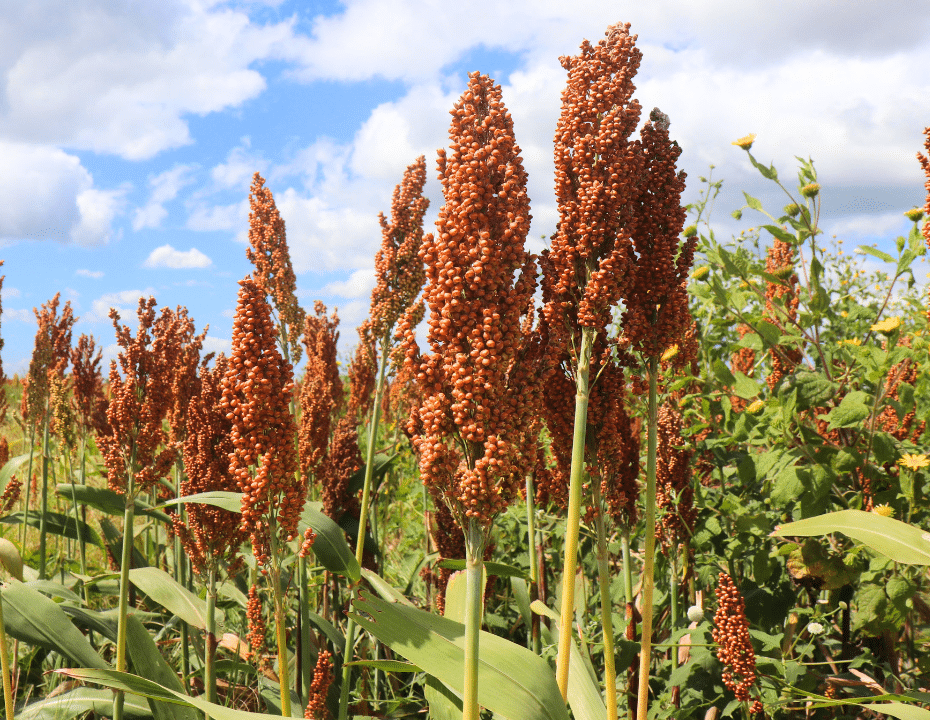
Wondering what went right this week in the conservation world? We’ve got you covered with our Conservation Optimism Round-Up! We are collating stories of optimism from around the globe so that you never miss your dose of weekly motivation. (Featured image: Sorghum, (image 5363747 by gutierrez_car14 from pixabay, accessed via Canva)
1. Women-led fire prevention and patrols restore forests in Thailand
“Volunteers in the Ban Pong community forest and fire management group have been restoring a 40-hectare forest area in Thailand’s Lampang province. They have planted native trees and revived the water table by building structures known as check dams in areas where water naturally flows, but dries up seasonally. Over the years, as moisture returned to the soils, natural regeneration has taken over, speeding the forest’s recovery.
Much of the year, they protect it against fire, patrolling regularly and operating a wildfire alert system that has gained recognition as a vital rapid response system helping villagers across the region manage seasonal fires. “When we started out, people were often surprised when they saw women like me venture out to extinguish blazes carrying heavy equipment,” says Rachaprapa Kamphud, who leads the community group. “What stands out about Ban Pong is how they include everyone in wildfire prevention,” adds Tornorsam, a regional project manager of community-based fire management at FECOFTC, an NGO supporting community forestry. “Women and youth are actively involved, not just watching from the sidelines … Their commitment to working together and willingness to share what works makes a real difference.”
The forest restoration has also done wonders for local wildlife. Members of the group listed various animals, such as lizards, kingfishers, wild boars, squirrels and deer as commonly seen in the community forest.”
“When we protect the forest, the forest protects us.” #rewilding #conservationoptimism https://t.co/M60fGTY30l
— Citizen Zoo (@CitizenZoo) September 21, 2025
2. Melbourne sewage farm acting as haven for 300 bird species
“Each year, over 200bn litres of sewage flow thorugh Werribee Sewage Farm, pumped through a series of huge lagoons to encourage and discourage growth of different kinds of bacteria. It takes about 35 days for wastewater to reach the final lagoon, where it can be recycled further or pumped into Port Phillip Bay.
“We have to meet certain guidelines to protect the bay, so there’s not too much nutrient going out causing algal blooms. But that nutrient goes out on to the sand and feeds a lot of the organisms that exist in that area. And that provides food for migratory shorebirds,” says McCormack, conservation and land officer with Melbourne Water. More than 300 species of birds have been recorded at the Western Treatment Plant, including many threatened species such as critically endangered orange-bellied parrots. Due to the constant supply of wastewater, the area is protected from drought, and in dry years has become a refuge for half of Victoria’s waterfowl.”
‘A mythical place’: how a Melbourne sewage farm became a haven for 300 species of birds The abundance of birdlife amid the grassy plains, marshlands and 200 lagoons of the Western Treatment Plant rivals Kakadu – and is a magnet for birdwatchers www.theguardian.com/environment/...
— John Holmes (@jhaue.bsky.social) September 21, 2025 at 11:51 PM
[image or embed]
3. New research shows indigenous territories can reduce risk of vector-borne or zoonotic diseases
“A new paper analyzing the relationship between Indigenous territories and the occurrence of 21 diseases in the Amazon biome over 20 years has suggested that healthy forests on protected Indigenous territories can help reduce disease incidence and risks to human health.
“Indigenous forests act as a sort of shield for health,” said study lead author Júlia Rodrigues Barreto, a postdoctoral researcher at the University of São Paulo in Brazil. Published in Communications Earth & Environment, the study is the first of its kind to look at all nine Amazonian countries. Its main contribution, according to Barreto, is to convey the importance of guaranteeing land rights for Indigenous peoples across the Amazon.
“The legal status of Indigenous territories (ITs) seemed to play a critical role in the potential of ITs to minimize disease incidence, with unrecognized ITs boosting especially fire-related incidence,” the researchers wrote. They hypothesize this is because legally protected Indigenous territories are less likely to be used for unsustainable activities like large-scale farming or logging. “It is truly important to give land rights over these territories to Indigenous people, not only because they should have this legal ancestral right, but also because they are providing a service for the entire community,” said study co-author Paula Ribeiro Prist, senior program coordinator for forests and grasslands at the IUCN, the global nature conservation authority.”
Researchers found that Indigenous territories can effectively reduce the risk of vector-borne or zoonotic diseases if they’re located in municipalities with at least 40% forest cover.
— Mongabay (@mongabay.com) September 21, 2025 at 12:17 PM
[image or embed]
4. Red squirrel population thriving on Isle of Wight, UK
“Red squirrels are thriving on the Isle of Wight where they have enough food and a suitable habitat to support a population that could almost double, a study has found. Using climate models, the researchers mapped how the red squirrel population would fare under different climate breakdown scenarios such as temperature changes and low levels of rainfall, finding no direct impact on their survivability and “a natural ability to adapt to a range of climatic conditions”.
There are an estimated 3,500 red squirrels on the Isle of Wight, the largest remaining population of the endangered species in southern England. While one sub-population is concentrated more towards the east of the island and the other towards the west, there are encouraging signs that two groups are beginning to mix, supporting the genetic diversity and overall health of future generations.”
Red squirrel population thriving on Isle of Wight and could almost double, study finds Researchers mapping how red squirrels would fare under climate breakdown scenarios found ‘a natural ability to adapt There are now an estimated 3,500 red squirrels on the Isle [www.theguardian.com/environment/](http://www.theguardian.com/environment/)...
— Imran Bristol (@imranicus.bsky.social) September 19, 2025 at 10:26 PM
[image or embed]
5. Rewilding lays foundation for recovery in Zhenda, Bulgaria
“Nestled in Bulgaria’s Rhodope Mountains, Zhenda is poised to become a beacon of nature recovery. The Rewilding Rhodopes Foundation has been working on the 3,800-hectare site since early 2024. Their work has included release of free-roaming European bison, fitted with GPS collars to enable community monitoring and tracking.
To restore their health and resilience, the forests of Zhenda will be rewilded in partnership with the Zhenda state forestry unit. Using GIS mapping and field surveys, the Rewilding Rhodopes team have identified pilot areas within the site with strong potential to support natural processes and richer biodiversity. They will focus on replacing non-native conifers with native broadleaf trees, and improving harvested forests so that they can regenerate naturally. Important features such as old trees, deadwood, and wildlife habitats will be protected, while forestry practices shift towards low-impact timber harvesting that benefits both people and nature.
The team is also partnering with a local tourism agency to create a network of eco-trails, and plans to collaborate with local people to market and sell authentic regional products, ensuring nature recovery brings tangible financial benefits to the local community.“
"In the coming years, the forests of Zhenda will regenerate naturally, while bison herds once again roam freely across the landscape." #rewilding #conservationoptimismhttps://t.co/BtgABMHp8K
— Citizen Zoo (@CitizenZoo) September 19, 2025
6. Grassroots community seeds sorghum in eastern Indonesia to adapt to climate change
“Gerep Blamu Tapobali Wolowutun (Gebetan) is an organization of young people bringing practical solutions to safeguard food security in the village of Tapobali in Indonesia. Villages such of Tapobali can endure droughts of up to nine months, with even hotter and drier weather estimated in the future. For community members Ambrosia Ero and Hendrikus Bua Kilok, the prospect of increasingly punishing heat required community action, prompting them to found Gebetan.
They began work planting bamboo and pea tree seedlings to help reinforce the water table. Later, some farmers told Ambrosia stories of past generations foraging a black variety of wild sorghum, known as kfarfolot. Volunteers conducted outreach communicating the benefits of sorghum — the world’s fifth-most farmed cereal crop — as a way of adapting to climate change. Students at the Wulandoni 4 Junior High School learned to bake cakes using sorghum. Before long, farmers’ fields that previously grew corn and rice were covered in flowering sorghum. And last year, the young volunteers began planting sorghum on an empty patch of land behind the junior high school.
Gebetan has since received 83 million rupiah ($5,000) in funding from the Samdhana Institute to support the small businesses selling cakes made by the middle school and roasted coffee blended with sorghum. Last year, Tapobali farmers recorded two bumper harvests, with plenty left over as seed to replant fields with in the community. The early success has sparked interest beyond Tapobali: “We’re grateful that now it’s not just our residents,” Ambrosia said. “Neighboring villages are also starting to plant sorghum.”“
In 2022, Ambrosia Ero and Hendrikus Bua Kilok joined forces in Lembata Island to boost locally grown food staples. They are now working to expand with crops that are better able to withstand the increasingly adverse growing conditions in East Nusa Tenggara province owing to climate change.
— Mongabay (@mongabay.com) September 19, 2025 at 12:10 AM
[image or embed]
7. 60th ratification of High Seas Treaty triggers entry into force
“At the United Nations this week, four new countries ratified the High Seas Treaty: Sri Lanka, St. Vincent and the Grenadines, Sierra Leone and Morocco. This means the High Seas Treaty has reached the milestone of 60 state ratifications needed to trigger its entry into force, and will become legally effective on 17th January 2026.
The Treaty is the first legally binding international agreement safeguarding marine life in the High Seas, which covers two-thirds of the world’s ocean and plays a critical role in ensuring a healthy planet. It provides new tools to halt biodiversity loss and ocean degradation through enabling the creation of marine protected areas (MPAs) in international waters and ensuring environmental impact assessments of planned human activities. It will also boost equity for developing countries through increasing knowledge and technology access, strengthening capacity, and ensuring the equitable access and sharing of the benefits of marine genetic resources. These provisions are vital to achieving climate and biodiversity global goals, including the Kunming-Montreal Global Biodiversity Framework (GBF) 30×30 target to protect 30% of the planet’s land and ocean by 2030.
“This historic moment is the culmination of years of dedication and global diplomacy by governments and stakeholders” said Rebecca Hubbard, Director of the High Seas Alliance. “The High Seas Treaty is a powerful testament to multilateralism- showing what the world can achieve when we come together for the common good for our ocean, which covers more than 70% of the planet. Today marks an important step when promises start becoming action.””
The High Seas Treaty just hit its 60th ratification and will enter into force Jan 2026! This is huge – a historic step to protect ocean life beyond borders. Now comes the hard part: making it real! [highseasalliance.org/2025/09/19/h](http://highseasalliance.org/2025/09/19/h)... #HighSeasTreaty #Ocean #OceanConservation #GlobalAgreement
— Henning Schoenenberger (@schoenenberger.bsky.social) September 21, 2025 at 2:00 PM
[image or embed]
Have a story to share for our weekly round-up? Use #ConservationOptimism on Twitter, Facebook, LinkedIn and Instagram!