Wondering what went right this week in the conservation world? We’ve got you covered with our Conservation Optimism Round-Up! We are collating stories of optimism from around the globe so that you never miss your dose of weekly motivation.
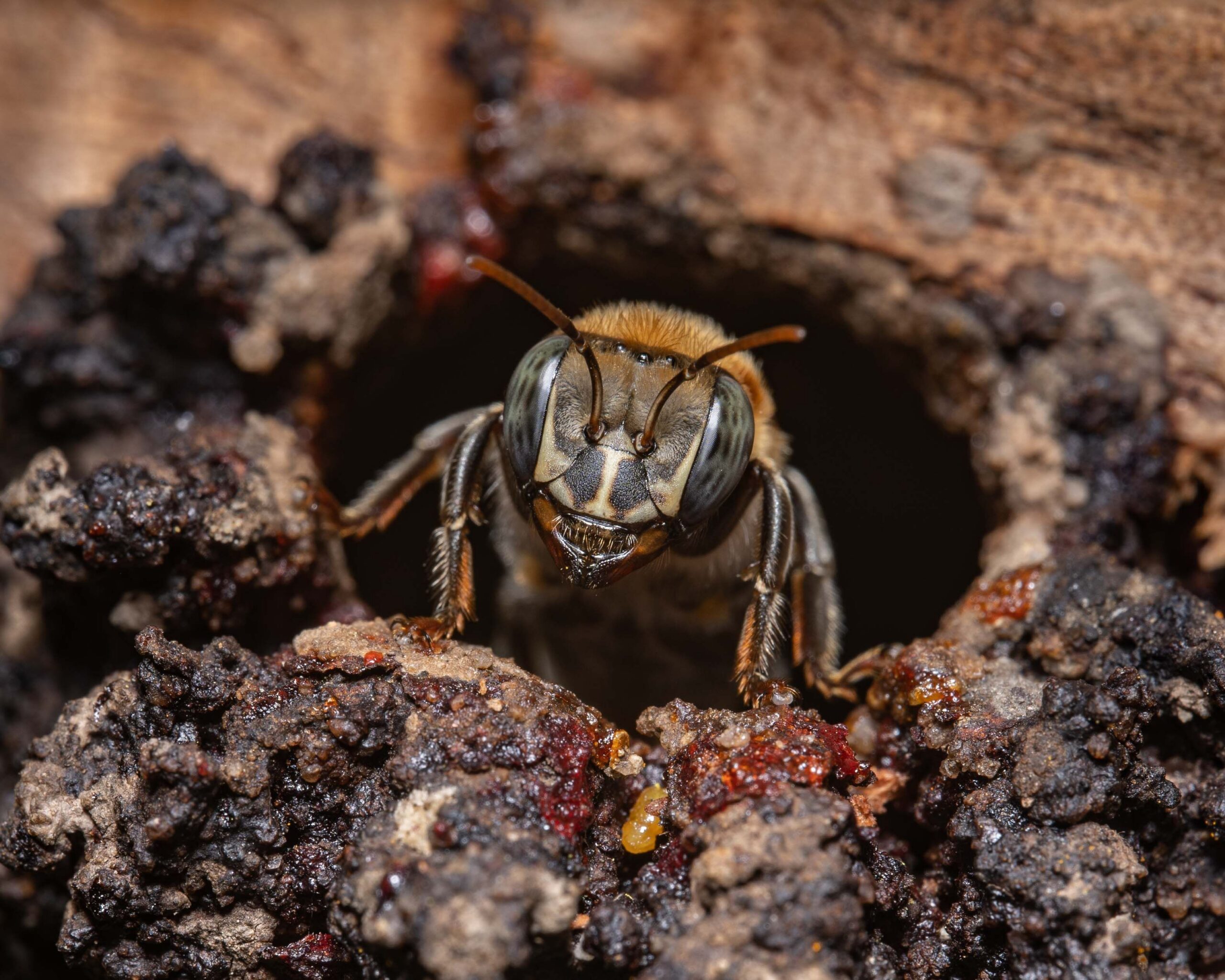
(Featured image credit: Bee emerging from a hive in Moyobamba, Peru. Bill Salazar via Pixels/ Creative Commons)
1. Native stingless bees receive legal rights in Peru
“Two municipalities in the Peruvian Amazon have granted native stingless bees the legal right to exist, thrive and be represented in court. This is the first time any insect has been recognized as a rights-bearing entity anywhere in the world, according to a correspondence published in Nature.
“The ordinances passed in the municipalities of Satipo and Nauta-Loreto guarantee the bees’ right to exist, reproduce and flourish. This establishes a legal framework allowing Indigenous groups and conservationists to sue on behalf of the bees.”
In a global milestone, Peru’s Satipo and Nauta-Loreto regions have recognized native stingless bees as rights-bearing entities. Backed by a 2025 national law, the framework allows legal action to shield critical pollinators from deforestation and pesticides. Liz Kimbrough reports for #Mongabay.
— Mongabay (@mongabay.com) June 18, 2026 at 7:00 AM
[image or embed]
2. Latest survey reveals good news for three UK heathland birds
Thanks to data from observations by over 1,000 birdwatchers in 2025, the RSPB has shared a report on the status of bird species with key links to the lowland heathland ecosystem: the Dartford Warbler, Woodlark, and Nightjar.
“The results so far paint a positive picture for all three species. The number of Dartford Warbler and Woodlark territories recorded have increased by around 27% and 29% respectively since 2006, while Nightjar saw the number of territories increase by around 20% since 2004. Both Woodlark and Nightjar show notable range expansion, with Nightjars breeding in increasing numbers in Scotland.”
RSPB Conservation Scientist Andrew Stanbury has said that the latest information will be invaluable to help guide future conservation actions and update species status assessments, such as the Birds of Conservation Concern Red, Amber and Green lists.
Latest survey reveals good news for three heathland birds RSPB Conservation Scientist Andrew Stanbury looks at the results of the latest Heathland Bird Surveys: www.rspb.org.uk/whats-happen... A huge thank you to the 1,200 birdwatchers who took part in this survey. @btobirds.bsky.social 🪶 🧪
— RSPB Science (@rspbscience.bsky.social) June 16, 2026 at 4:23 PM
[image or embed]
3. French Polynesia expands marine protected area to cover 30% of its waters
“The government of French Polynesia announced it is expanding the extent of ocean where extractive industries like seabed mining and industrial fishing will not be allowed. With this move, 30% of French Polynesia’s waters will now be fully protected.”
Last June, the government of French Polynesia, a French overseas territory, established the Tainui Atea marine protected area. According to Mongabay, “It spans nearly 5 million square kilometers (2 million square miles) of its exclusive economic zone, the area of ocean that French Polynesia has exclusive rights to conserve and manage.” Of this area, around 900,000 square kilometers is completely protected from extractive mining and fishing.
This year, French Polynesia’s President Moetai Brotherson announced that this fully protected area is to be expanded by another 520,000 km2, even larger than the size of France.
President Moetai Brotherson announced an expansion of marine protections, placing 30% of French Polynesia’s waters under full protection from industrial fishing and seabed mining. The 1.4 million-sq-km (540,500 mi2) reserve shields critically endangered sharks, marine mammals, and seabirds.
— Mongabay (@mongabay.com) June 18, 2026 at 10:07 PM
[image or embed]
4. Solar cold storage helps African farmers cut losses and reach global markets
“The pay-per-use model offered by cold-chain company SoKo Fresh charges farmers based on kilograms (pounds) stored, part of a trend in Africa toward using solar-powered cold storage to help prevent one of agriculture’s most persistent problems: food spoilage.
“The Food and Agriculture Organisation estimates that up to 40% of food produced in Africa is lost between harvest and market, largely due to poor storage, transport, and processing infrastructure.
“Solar-powered, off-grid cold rooms, warehouses and cooling hubs allow farmers and traders to preserve perishable goods without relying on expensive and unreliable electricity grids. This shift is gaining momentum across Kenya, Nigeria, Ethiopia, Rwanda and South Africa.”
Less greenhouse gas emissions AND less food waste. My news to me good news for June 16 #EarthOptimism https://t.co/qUht1bGHbD
— Dr. Nancy Knowlton (@SeaCitizens) June 16, 2026
5. The ‘miracle plant’ helping revive South Africa’s Eastern Cape ecosystem
“‘It’s wet here now, Kwandwe is looking beautiful,’ says [Doc] Ndyawe, a ranger at the 30,000-hectare Kwandwe Private Game Reserve. ‘But not even long ago, it was very dry here. Five years back it was almost like dust.’
“The Eastern Cape still boasts the rhinos, elephants and big cats that draw international tourists, partly thanks to a growing drive to restore the dense thickets that once blanketed its valleys and plains.
“At the heart of this push is spekboom (Portulacaria afra), a shrub or small tree that experts consider key to reviving vast areas extensively degraded by overgrazing, invasive species and drought, making both ecosystems and communities more resilient in the face of climate pressures.”
In South Africa’s Eastern Cape, people and nature are flourishing, thanks to #GenerationRestoration efforts driven by spekboom—a shrub that retains water, withstands drought, and supplies fodder for livestock and wildlife when other vegetation fails.
— UN Environment Programme (@UNEP) June 19, 2026
Explore more:… pic.twitter.com/59gLERt4ET
6. As more bans go into effect, more Styrofoam is kept from entering and polluting the ocean
With the threat it poses to the environment and to the health of humans and animals alike, cities and states in the US have passed legislation banning plastic foam in food ware. In some cases, such as in Washington D.C., laws go even further to ban disposable coolers and packing peanuts.
Christy Leavitt, a senior campaign director at Oceana, explains, “If we had been here a little bit more than 10 years ago, we would have seen a lot more plastic foam. So, the good news is not only did D.C. put in place a policy, but so too did Montgomery County, Maryland, and Prince George’s County, Maryland, which are all the jurisdictions that have tributaries that flow into the Anacostia River, so those all went into effect during 2016 and that means that the river got a lot cleaner.”
Across the U.S., bans on plastic foam protect nearby waterways.
— Oceana (@oceana) June 16, 2026
“If we had been here more than 10 years ago, we would’ve seen a lot more plastic foam,” says Christy Leavitt, Oceana’s Senior Campaign Director.
Foam bans work. Watch below👇https://t.co/cmsOvBADIQ
7. The community-led marine conservation projects in Africa on which 30×30 depends
“More than 5,000 delegates are gathering in the Kenyan coastal city of Mombasa for a major global conference on the future of the oceans. At the heart of the discussions is ocean governance and the global push to meet the 30×30 target — protecting 30% of the world’s land, freshwater and oceans by 2030.
“But meeting that goal will depend not only on governments and international pledges, but also on community-led organizations doing the difficult work of conserving fragile marine ecosystems.
“Across Africa and around the world, thousands of grassroots groups are carrying out this work, often far from the spotlight, helping shape ocean conservation and blue economies that support local livelihoods. Mongabay spoke with representatives of four such organizations working across the continent from the Western Indian Ocean to Africa’s Atlantic coast.”
Global ocean governance is taking center stage in Kenya. While international pledges aim to protect 30% of the world's oceans by 2030, thousands of African grassroots groups are driving the practical conservation work needed to sustain marine ecosystems and local blue economies.
— Mongabay (@mongabay.com) June 19, 2026 at 11:35 PM
[image or embed]
Have a story to share for our weekly round-up? Use #ConservationOptimism on Twitter, Facebook, LinkedIn and Instagram!