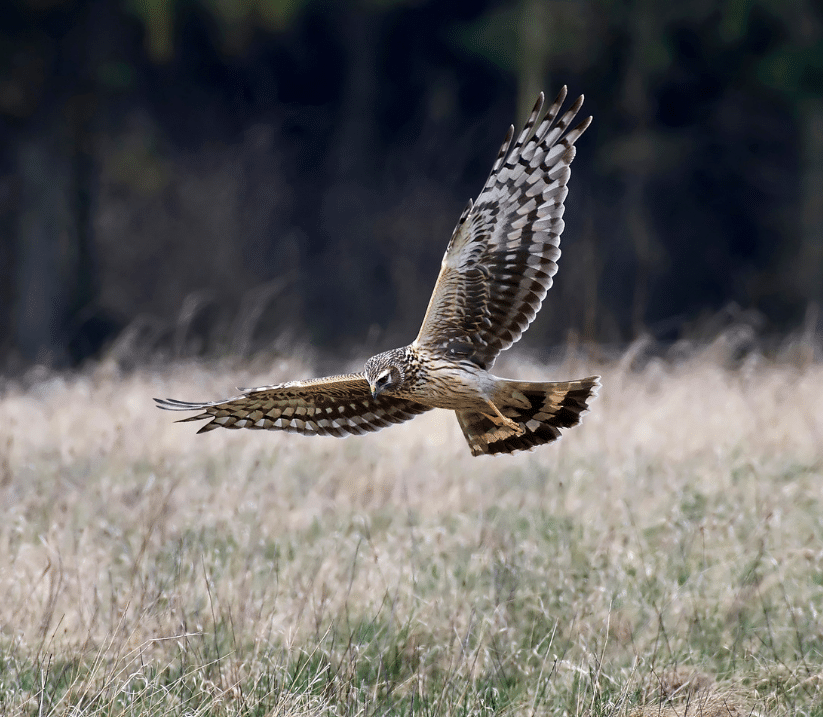
Wondering what went right this week in the conservation world? We’ve got you covered with our Conservation Optimism Round-Up! We are collating stories of optimism from around the globe so that you never miss your dose of weekly motivation. (Featured image credit: Hen harrier, by Denja1 from Getty Images Pro).
1. Rare bongo’s birth a ‘win for global conservation’
“A rare mountain bongo calf has been born in Woburn Safari Park, UK, in “a significant milestone for one of the world’s most endangered large mammals”. This type of antelope is listed as critically endangered in the wild, where it is believed fewer than 100 remain.
A spokeswoman for the park said: “Eastern mountain bongo have suffered devastating losses due to habitat destruction, poaching and disease. Every successful birth in a managed breeding programme is a meaningful contribution to their conservation. Already the calf is showing signs of healthy development and has begun bonding with her older siblings, Djembe and Ziggy, both born at Woburn in recent years.””
Birth of mountain bongo at Woburn ‘win for global conservation’ https://www.newsbeep.com/il/86325/ Another male calf was born at Woburn in May this year, to first-time mother Odongo and father Sonny.…
— il-nb.bsky.social (@il-nb.bsky.social) October 20, 2025 at 10:30 AM
[image or embed]
2. New frog and gecko species discovered on remote island in Australia’s north
“Three new animal species – two frogs and a gecko – have been discovered on a remote island in Australia’s north. The animals were found on Dauan Island, a 3 sq km island in the far northern Torres Strait.
Conrad Hoskin, an associate professor and terrestrial ecologist at James Cook University, described the new species after a research expedition to Dauan. “On the second night, when it was raining, there were these two really distinct frog calls,” Hoskin said. “Sure enough, they were species new to science.”
Torenzo Elisala, a Dauan Island councillor, said the discoveries “highlight how special our island is. Our community has been tucked away in the Guda Maluilgal nation for millennia, sharing the spiritual connection from flora to fauna to that of our ancestors who lived on these lands before us,” he said. “These discoveries are exciting to learn more about science and add to the tourism potential of the island.””
Different croaks: new frog and gecko species discovered on remote island in Australia’s north Researchers on expedition to Dauan Island heard two distinct frog calls in the rain and ‘sure enough, they were species new to science’ [www.theguardian.com/environment/](http://www.theguardian.com/environment/)...
— Robb Edwards 🌱 (@robedwards1.bsky.social) October 16, 2025 at 10:09 PM
[image or embed]
3. AI aids conservation of rare birds on Orkney islands
“Conservationists on the Orkney islands have been using artificial intelligence programmes have been trained to detect stoats, in one of the world’s largest mammal eradication projects. The stoat is an existential threat to native ground-nesting birds for which Orkney is famous – it is home to 11% of all the UK’s breeding seabirds and about 25% of its hen harriers, as well as its most treasured native rodent, the Orkney vole.
The project is deploying heat-detecting cameras, using AI to identify the stoats by their shape and movement, and informing trapping teams to find and kill the stoats. Conservationists have already used an array of 9,000 lethal traps and eight detection dogs over the past six years. At least 30 of the digital cameras will soon be staked out across the moors and coasts of Orkney’s mainland.
It’s a much more accurate monitoring tool than a usual trail camera would be,” says James Geluk, the project’s lead technologist.
The latest survey data suggests the project has succeeded. Since it began in 2019, there has been a 1,267% increase in the chance of curlew hatchings, a 218% rise in vole activity and a 64% increase in hen harriers numbers. Hen Harriers are heavily persecuted by gamekeepers on the UK mainland, but now Orkney is home to 160.”
‘There were stoats in kitchen cupboards’: AI deployed to help save Orkney’s birds
— The Guardian (@theguardian.com) October 19, 2025 at 12:32 AM
[image or embed]
4. New female jaguar released in El Impenetrable National Park, Argentina
“A female jaguar, Acaí, was released in El Impenetrable National Park this October. The release was carried out by The National Parks Administration (APN), the Rewilding Argentina Foundation (FRA), and the Province of Chaco.
Acaí is the fifth jaguar to be released as part of the species supplementation project in this protected area. This action is part of the strategy for the population recovery of the jaguar in the Argentine Gran Chaco, a project driven by the APN and the FRA with the support of the provincial government. It is hoped her release will increase the chances of reproduction with the wild males in the area and continue strengthening the dwindling jaguar population of the Chaco region, both in the number of individuals and in genetic diversity.”
"The purpose of her release is to increase the chances of reproduction with the wild males in the area and, in this way, continue strengthening the dwindling jaguar population of the Chaco region" #rewilding #conservationoptimism https://t.co/qvgTkr3Mko
— Citizen Zoo (@CitizenZoo) October 18, 2025
5. Conservation win for Spain as six marine protected areas declared
“In a major step toward strengthening marine conservation, Spain has announced the designation of five new marine protected areas (MPAs) and one area of special importance for seabirds. The decision, made by the Ministry for the Ecological Transition and the Demographic Challenge, adds 17,000 km² of marine space to the country’s protected waters – bringing Spain closer to its goal of safeguarding 25% of its marine territory by the end of 2025.
The announcement marks a milestone in Spain’s efforts to meet its commitments under the EU Biodiversity Strategy for 2030 and the international targets set at the UN Ocean Conference. Spain’s marine protection coverage now stands at 22.45%. “It is deeply satisfying to see these high-value ecological areas finally receive protection,” said Michael Sealey, policy advisor for Oceana in Europe.”‘
Kudos 🇪🇸 👏. #OceanOptimism #MPAs #30by30 oceanographicmagazine.com/news/conserv...
— 🌊Markus Knigge🐟 (@oceanknigge.bsky.social) October 17, 2025 at 1:32 PM
[image or embed]
6. Pine Martens released into Exmoor National Park, UK
“9 female and 10 male pine martens have been released in secret locations owned by the National Trust and Exmoor National Park Authority.
The pine martens were sourced from healthy wild populations in the Highlands of Scotland, where they underwent health checks. They were then driven more than 500 miles through the night in a specially adapted, temperature-controlled vehicle.
Devon Wildlife Trust’s Tracey Hamston, who leads the Two Moors Pine Marten Project, that it was “wonderful to see pine martens living wild in Exmoor again. These animals were once a key part of our thriving woodland wildlife, so it’s good that they are back where they belong. It’s a positive sign that nature can be restored. Our woodlands and their wildlife will benefit from their presence.””
“It’s a positive sign that nature can be restored. Our woodlands and their wildlife will benefit from their presence.” #rewilding #conservationoptimismhttps://t.co/m3cSi0dDJ9
— Citizen Zoo (@CitizenZoo) October 17, 2025
7. New cluster of Tapanuli orangutans discovered in Sumatra peat swamp
“Since it was first described by scientists in 2017, the Tapanuli orangutan, one of the world’s rarest great apes, was believed to live only in the Batang Toru forest of Indonesia’s North Sumatra province. But new findings reveal that the species (Pongo tapanuliensis) also inhabits a peat swamp forest some 32 kilometers (20 miles) away, adding a new layer to the understanding of its range.
Researchers have confirmed that the critically endangered Tapanuli orangutan, previously thought to live only in Sumatra’s Batang Toru forest, also inhabits a peat swamp forest 32 kilometers (20 miles) away in the Lumut Maju village forest. DNA analysis of fecal samples verified the Lumut Maju apes as Tapanuli orangutans, marking the first confirmed record of the species outside Batang Toru.”
Researchers have confirmed that the critically endangered Tapanuli orangutan, previously thought to live only in Sumatra’s Batang Toru forest, also inhabits a peat swamp forest 32 kilometers (20 miles) away.
— Mongabay (@mongabay.com) October 19, 2025 at 12:17 PM
[image or embed]
Have a story to share for our weekly round-up? Use #ConservationOptimism on Twitter, Facebook, LinkedIn and Instagram!