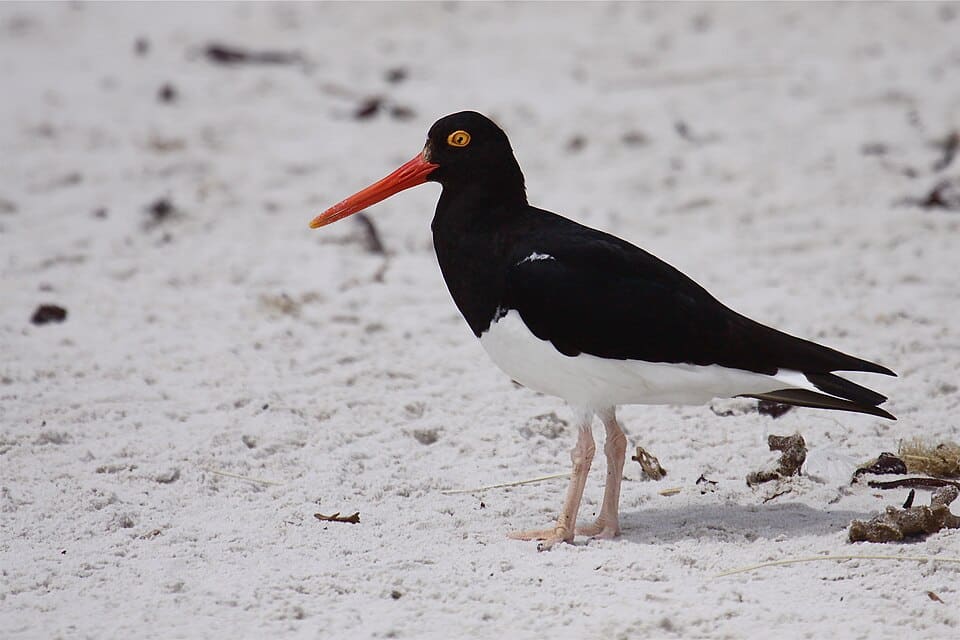
Wondering what went right this week in the conservation world? We’ve got you covered with our Conservation Optimism Round-Up! We are collating stories of optimism from around the globe so that you never miss your dose of weekly motivation. (Featured image credit: Magellanic Oystercatcher via Wikimedia Commons)

1. 150 species across the UK recovering, thanks to multi-million pound funding for targeted conservation
Natural England, a non-departmental public body in the UK, has funded extensive conservation initiatives around the country through a £12.8 million Capital Grant scheme. A new report has shown that these have helped support the recovery of 150 species, including insects, mammals, and birds, with conservationists relocating more than 15,000 individual animals and plants to expand the species’ territories.
“According to Natural England, rare species have returned to areas they have not been seen in for generations,” reports an article in the Guardian. However, the organization’s chair stresses the need for more collective action and funding.
“We will need to see increased ambition on species recovery, particularly looking at what can be done on some of our lost species. In the coming years, habitat management and creation alongside species reintroductions could be a real gamechanger for the health of ecosystems and help us achieve the country’s legally binding targets.”
£12.8 million in funding has helped 150 different species across England.
— Natural England (@NaturalEngland) August 13, 2025
Here’s a few success stories from the 78 partners involved in the Species Recovery Programme Capital Grant Scheme. 👇https://t.co/n0rOgEnfLj pic.twitter.com/YnGS5qCmJa
2. How a gecko species defied extinction on a Galápagos island
On Rábida Island in the Galápagos, the Mares’s leaf-toed gecko had not been seen in over a century, after invasive brown rats introduced by ships in the 17th and 18th centuries devastated their populations, “feeding on their eggs and disrupting their nesting sites.”
After a 2011 program successfully eradicated all rats from the island, the tiny geckos were spotted by rangers only a year later: “the first living sighting in recorded history.” Genetic analysis also confirmed that the geckos on Rábida as a distinct, ‘evolutionarily significant unit’, highlighting their unique conservation value.
“The swift recovery of biodiversity we continue to see on islands across the globe tells us that nature, and island ecosystems in particular, are extremely resilient,” Paula Castaño, Island Conservation’s impact program manager told Mongabay. “It shows us that it only takes a few people, government willingness, and funding support to help these remarkable ecosystems recover and bring species back from the brink of extinction.”
“The swift recovery of biodiversity we continue to see on islands across the globe tells us that nature, and island ecosystems in particular, are extremely resilient" #rewilding #conservationoptimismhttps://t.co/Hyfpyxaz4p
— Citizen Zoo (@CitizenZoo) August 17, 2025
3. Indigenous culture leads modern conservation in Australia
“Matuwa Kurrara Kurrara is a conservation and cultural success story in the making, a park co-managed by the Martu people and the Western Australian State Government—in Australia, states and territories create and manage national parks.
“The Government created the park in 2023, thanks in part with support from The Pew Charitable Trusts, and the co-management arrangement is a groundbreaking step toward restoring Martu stewardship of hundreds of thousands of square miles. This is but a fraction of the vast area the Martu people traditionally lived on and were forcibly removed from in the 1900s to make room for cattle ranching and mining.”
Now, Martu Elders are advising the Australian Department of Biodiversity, Conservation, and Attractions (DBCA) on park decisions, and indigenous rangers patrol the park’s territory and monitor the species thriving within it. Read more about how the Martu people are restoring this outback landscape and preserving their ancient culture here.
Martu Rangers in Australia light cool-burn fires, track bilbies, and combine cultural stories with ecological data. When culture leads, conservation follows. More in Trust magazine. https://t.co/CvSvNul4eJ pic.twitter.com/KEEzu1c1wn
— Pew Environment (@pewenvironment) August 14, 2025
4. Lioness sighting in Central African Republic a ‘hopeful sign’ for northern subspecies
“An adult lioness has been photographed for the first time in six years in Bamingui-Bangoran National Park in the Central African Republic. The photo, taken in April by a camera trap installed by the Wildlife Conservation Society, shows a lactating female, possibly with cubs nearby, wandering the forest at night — the first evidence of a breeding female in this landscape.
“This is a truly exciting and hopeful sign for lions in the region,” Armand Luh Mfone, WCS’s director of programs for CAR, said in a press release. Camera traps so far have recorded only males, so this latest sighting “demonstrates that with strong protection efforts, this landscape still has the potential to support a thriving lion population.”
An adult lioness has been photographed for the first time in six years in Bamingui-Bangoran National Park in the Central African Republic. The photo, taken in April by a WCS camera trap, shows a lactating female, possibly with cubs nearby, wandering the forest at night.
— Mongabay (@mongabay.com) August 17, 2025 at 3:02 AM
[image or embed]
5. Six new exceptional protected areas around the globe added to the IUCN Green List
“From the misty mountains of China’s Sichuan Province to the coral-rich waters off Colombia’s Pacific coast, six exceptional protected areas have been added to the IUCN Green List of Protected and Conserved Areas, the global standard for effective and equitable area-based conservation.
“These new additions span two continents and a remarkable range of ecosystems, including panda habitats, volcanic sanctuaries, marine biodiversity hotspots and ancient cultural landscapes. Through rigorous assessments, each site has demonstrated achievements in conservation, community engagement and governance, earning their place among the world’s best-managed protected and conserved areas.”
Read about these amazing conservation sites featured in the IUCN’s article here.
🌿 Six extraordinary protected areas have just been added to the #IUCNGreenList, showcasing global excellence in conservation!
— IUCN (@IUCN) August 11, 2025
From China's remote mountain reserves to Colombia’s coastal and volcanic ecosystems, these sites represent what’s possible when #biodiversity… pic.twitter.com/zUoO4TgP70
6. Global wetlands conference results in resolutions for protection & restoration
“In July, scientists, government officials and community leaders gathered in Zimbabwe for the 2025 international conference on wetlands to agree on global commitments for the sustainable conservation and restoration of these ecosystems.
“The conference adopted a series of resolutions and agreements, including one on the protection of migratory birds and wetland-dependent species, as well as the Fifth Strategic Plan, which aims to halt and reverse wetland loss by 2034. The strategic plan highlighted the importance of including youth, Indigenous peoples, women and local communities in successful wetland conservation efforts.
“We need to recognize that wetlands are fundamental to the water cycle that our planet depends on,” said Hugh Robertson, chair of the Ramsar Convention’s Scientific and Technical Review Panel, “for our global response to climate change, protecting threatened species and the well-being of billions of people.”
In July, scientists, government officials and community leaders gathered in Zimbabwe for the 2025 international conference on wetlands to agree on global commitments for the sustainable conservation and restoration of these ecosystems.
— Mongabay (@mongabay.com) August 14, 2025 at 1:18 AM
[image or embed]
7. US readers: Take part in coastal conservation with a smartphone and a coin
To monitor how beaches change, erode, and build up in different places, scientists in the US have developed SandSnap to engage citizen scientists in helping gather data from beach sands across the United States, including freshwater sites. This understanding of beach topography, down to the size of the sand grains, will play a crucial role in predicting impacts on coastal wildlife like shorebirds, and make better, more informed conservation decisions.
“SandSnap data has already been included in a few feasibility studies, but to become widely useful the project needs more reports, spanning a longer time range. “We need the database to be as large and robust as possible,” Young says. That’s where you come in.”
Heading to the beach this weekend? Become a community scientist by contributing to a crowdsourced sand database—a growing and critical resource for habitat and bird conservation. Here's how: https://t.co/EDz0U0rpui pic.twitter.com/CmtgeMpmBw
— Audubon Society (@audubonsociety) August 15, 2025
Have a story to share for our weekly round-up? Use #ConservationOptimism on Twitter, Facebook, LinkedIn and Instagram!