
Wondering what went right this week in the conservation world? We’ve got you covered with our Conservation Optimism Round-Up! We are collating stories of optimism from around the globe so that you never miss your dose of weekly motivation.
(Featured image credit: Wikicommons )

1. Kashmir’s birders are building a grassroots conservation movement
“From the wetlands of Srinagar to the forests of Dachigam National Park – home to the endangered Kashmir stag, or hangul – amateur birders are documenting species, reporting poaching incidents and contributing data to global scientific platforms.
Conservationists say the movement is helping fill long-standing gaps in ecological research in Kashmir, where decades of political instability hindered sustained environmental documentation.”
How Kashmir's birders are building a grassroots conservation movement ->Anadolu Agency | More on "Kashmir grassroots birding conservation movement" at BigEarthData.ai | #Conservation
— Climate, Ecology, War & More - Dr Glen Barry BigEarthData.ai (@bigearthdata.ai) May 19, 2026 at 6:52 PM
[image or embed]
2. £7.7m initiative targets pollution at source in England’s overlooked headwaters
“The programme ‘Headstart: unlocking the value of headwater catchments’ has been named a winner in the sixth Water Breakthrough Challenge by Ofwat’s Water Innovation Fund.
Led by Anglian Water and Freshwater Habitats Trust in partnership with a wide range of environmental organisations, Headstart will develop practical ways to improve water quality and freshwater biodiversity by targeting problems upstream, in headwaters at the top of river systems.”
£7.7m initiative targets pollution at source in England’s overlooked headwaters #nature #wildlife #biodiversity #ecology #environment #habitats #conservation #sustainability #climatechange #pollution #rivers insideecology.com/2026/05/19/7...
— Inside Ecology (@insideecology.bsky.social) May 19, 2026 at 4:15 PM
[image or embed]
3. Elephants return to Mount Elgon side of Uganda after four decades
“According to monitoring with tracking collars by the Mount Elgon Foundation (MEF), last year at least 60 elephants crossed from Kenya into the Ugandan side of Mount Elgon, a vast volcanic mountain that straddles the border, returning to a part of their natural range where they’ve not been seen for over 40 years.”
atcnews.org/elephants-re... #Africa #Conservation #SavetheElephants #Uganda #MountElgonNationalPark
— ATCNews.org (@atcnews.bsky.social) May 19, 2026 at 9:48 AM
[image or embed]
4. Jogger’s Call for Help Saves Critically-Endangered Penguin Found Face-Down on the Beach
“Two weeks ago, wildlife veterinarian Catherine Hauw was alerted that there was an African penguin lying helplessly on a beach with its head buried in the sand.
The 35-year-old medic rushed to the scene at Brenton-on-Sea in South Africa alongside a medical assistant and discovered the critically endangered bird weak and motionless with its beak in the sand.
Using a towel and a box, the rescuers carefully transported the penguin from to a nearby veterinary clinic for urgent treatment.
After being treated with electrolytes for dehydration at the clinic, the bird, which was not malnourished, was transported to a specialist sanctuary where it will be rehabilitated before being released back into the wild.”
Jogger’s Call for Help Saves Critically-Endangered Penguin Found Face-Down on the Beach: Rescuers raced to save a stranded penguin after a jogger spotted it and called for help. Two weeks ago,… @goodnewsnetwork.org #PenguinRescue #EndangeredSpecies #WildlifeConservation #GoodNews #SaveThePenguins
— Donna E (@edwardsdna.bsky.social) May 18, 2026 at 2:06 AM
[image or embed]
5. A Bridge Built for Badgers
“This month, the UK’s first heathland green bridge opens over one of Surrey’s busiest stretches of road. It smells nothing like a motorway. And if you are a badger, a grass snake, or a common toad trying to get from one side of the A3 to the other, it is rather good news.”
A Bridge Built for Badgers blog.rolfskeldon.com/2026/05/17/a... #RolfSkeldon #IdeasThatMatter #WildlifeConservation #EcoNews
— Rolf Skeldon (@rolfskeldon.bsky.social) May 17, 2026 at 1:13 PM
[image or embed]
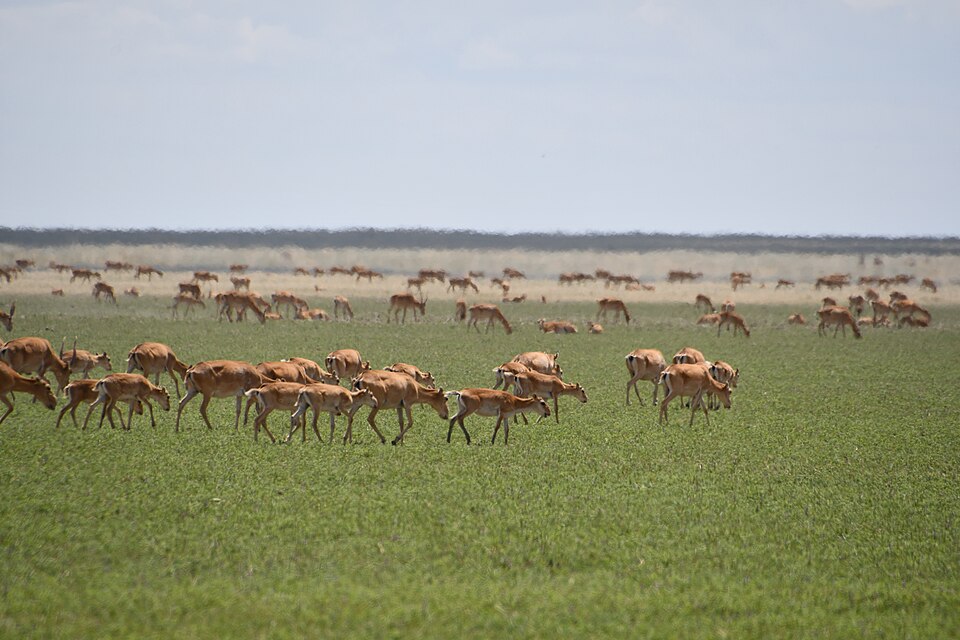
6. Return of large grazers to curb steppe fires and restore ecosystems in Kazakhstan
““The steppe grassland ecosystem cannot really be healthy without a big grazer,” said Vera Voronova, executive director of the Association for the Conservation of Biodiversity of Kazakhstan (ACBK), on the sidelines of the Regional Ecological Forum 2026 in Astana in April. “Without that, a lot of dry grass will be produced.”
Reintroduction of saiga antelopes had broader implications for the overall health of the steppe ecosystem. Bne IntelliNews #EcosystemRestoration #SaigaAntelope #Biodiversity #WildlifeConservation #SustainableEcosystems
— bne IntelliNews (@intellinews.com) May 13, 2026 at 5:54 PM
[image or embed]
7. The Turtle That Came Back
“For more than forty years, the green sea turtle appeared on the IUCN Red List as Endangered. In October 2025, the IUCN formally reclassified the green sea turtle as Least Concern.
It did not move one category. It did not inch forward gradually. It skipped two classifications entirely, jumping straight from Endangered to Least Concern without pausing at Vulnerable or Near Threatened. In the history of the Red List, that kind of movement is rare. It represents one of the most significant conservation recoveries ever recorded.”
The Turtle That Came Back blog.rolfskeldon.com/2026/05/13/t... #RolfSkeldon #IdeasThatMatter #OceanConservation #WildlifeConservation #EcoNews #MarineLife #ProtectOurOceans #SeaTurtles #GreenSeaTurtle
— Rolf Skeldon (@rolfskeldon.bsky.social) May 13, 2026 at 2:04 PM
[image or embed]
Have a story to share for our weekly round-up? Use #ConservationOptimism on Twitter, Facebook, LinkedIn and Instagram!
