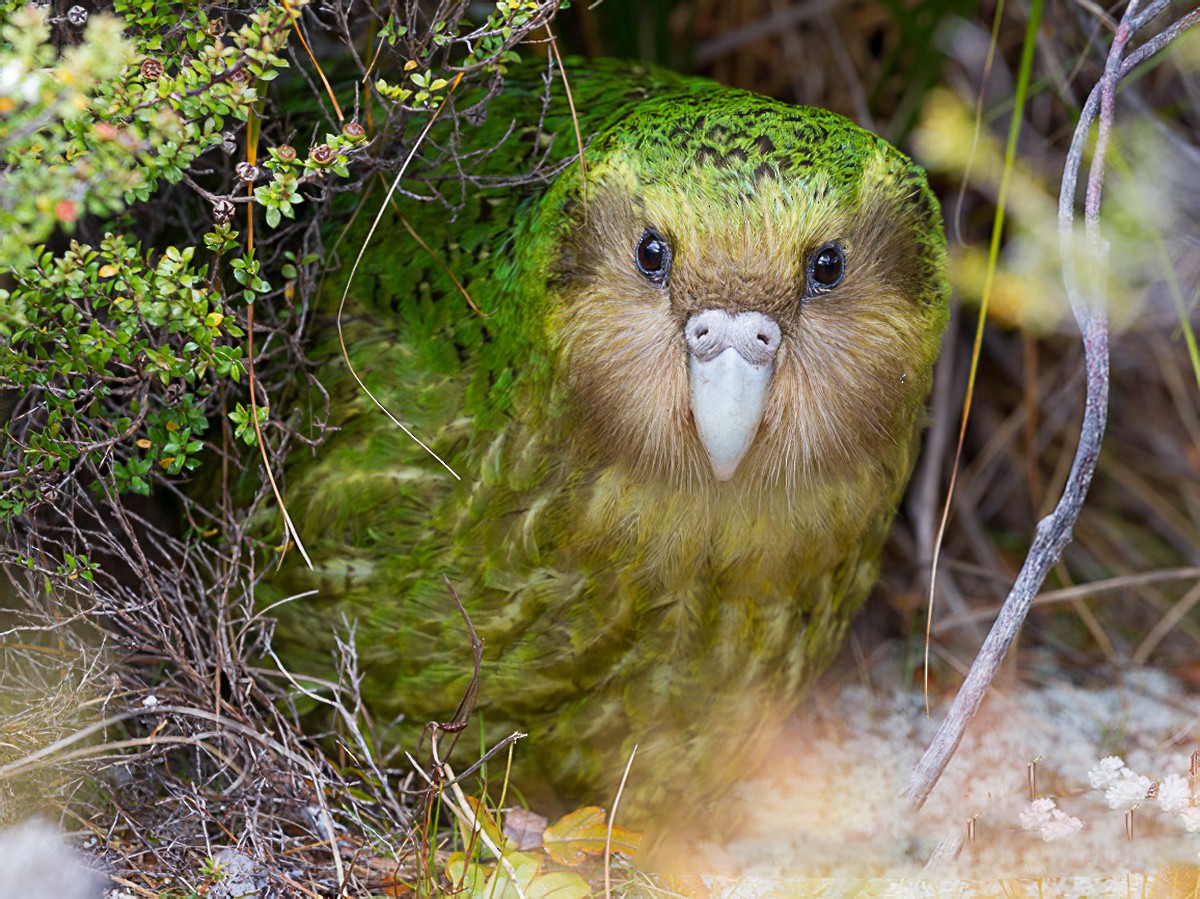
Wondering what went right this week in the conservation world? We’ve got you covered with our Conservation Optimism Round-Up! We are collating stories of optimism from around the globe so that you never miss your dose of weekly motivation. (Featured image credit: Kākāpō by Brent Stephenson via eBird)
1. First kākāpō chick in four years hatches on Valentine’s Day
“Kākāpō Yasmine hatched an egg fostered from kākāpō Tīwhiri on Valentine’s Day, bringing the total number of kākāpō to 237 – though it won’t be officially added to the population until it fledges.
New Zealand Department of Conservation Operations Manager for kākāpō and takahē Deidre Vercoe says the first chick of the breeding season is an exciting moment on the long road to recovery for this critically endangered species. “These exceptionally rare taonga [a Maori word used to refer to precious possessions in Maori culture] only breed every 2–4 years, so it’s a long time between chicks. We have more breeding-age birds than ever before this season, so we’re anticipating many more chicks to come.”
Read on and learn more about New Zealand’s kākāpō recovery program here!
The first #kakapo chick for four years hatched two days ago (on Valentine’s Day for those who like to anthropomorphise!). Here’s Tiwhiri-A1-2026 in Yasmine’s nest. 📸: Deidre Vercoe. www.doc.govt.nz/news/media-r... #kakapo2026 #conservation #parrots #birds
— Andrew Digby (@digs.bsky.social) February 16, 2026 at 7:48 AM
[image or embed]
2. New ‘whale-safe’ fishing gear approved in California, protecting wildlife and supporting fishermen
The California Department of Fish and Wildlife has approved “whale safe” pop-up gear fleet-wide for fishermen harvesting Dungeness crab, extending their window for pulling up the crustaceans off the California coast. The decision by the agency is being heralded as a milestone in collaboration and a breakthrough for conservation.
“Authorizing pop-up gear is a huge step toward ensuring fishermen can catch more crab without worrying about entangling a whale, and consumers can enjoy that crab caught during the spring knowing that it is whale safe,” said Geoff Shester, a marine scientist for Oceana, who has been part of the California Dungeness Crab Fishing Gear Working Group, adding he is hopeful other states will follow California’s lead.
Local fisherman Steve Melz is happy that the solution benefits both the fishermen and marine life. With about 175,000 pots in the waters off California, he and other fishers don’t want to see marine mammals or turtles harmed. “It’s kind of been environmentalists against the fishermen butting heads,” he said of the earlier years. “This is the first time we’ve worked in collaboration.
GOOD NEWS: California just approved pop-up fishing gear to prevent marine life entanglements and restore springtime fishing for Dungeness crab fishers.
— Oceana (@oceana) February 11, 2026
This win-win victory is a result of innovative fishers & campaigning by Oceana and our allies.
Read: https://t.co/Sbaybkrcfp
3. In Kenya’s Jomvu Creek, women help restore a vanishing coast through crab farming
On the outskirts of the coastal Kenyan city of Mombasa, a women’s organization in Jomvu Creek aims to transform livelihoods and the environment through mud crab farming. A blue economy grant is allowing the women to establish a crab-fattening enterprise and build a boardwalk through the creek, with hopes of boosting ecotourism.
Beyond income, the Jomvu women see themselves as caretakers of the creek, linking crab farming to mangrove restoration and planting nearly 1 million seedlings; the trees stabilize the shoreline, reduce erosion and create nursery habitats for fish and crabs.
The Coastal Women in Fisheries Entrepreneurship network now connects more than 2,000 women across the coastal region, supporting access to credit, training and markets. “Jomvu Women in Fisheries and Culture are a good example of what women can do when given opportunity,” says founder Mercy Mghanga.
Near Mombasa, women in Jomvu Creek are transforming livelihoods through mud crab farming. A blue economy grant supports crab fattening, ecotourism and mangrove restoration — with nearly 1 million seedlings planted to protect the shoreline and sustain fish nurseries.
— Mongabay (@mongabay.com) February 15, 2026 at 12:14 AM
[image or embed]
4. The seed-guardian family of the Amazon
In the Indigenous Quichua community of Alto Ila, Ecuador, Ramón Pucha and his family have spent years recreating their own piece of jungle with rescued species on a 32-hectare farm called El Picaflor. “I have a passion for nature, for plants, for animals,” says Pucha, 51, noting that his drive to protect the environment is so intense that many people in his community consider him “crazy.”
To save endangered plant species, Pucha ventures deep into the jungle, often alone, for up to five days at a time. Once the seeds reach home, Pucha’s wife, Marlene Chiluisa, takes charge. She plants them in suitable soil and compost so that they can begin to grow into plants that are then replanted in the rainforest.
Though Ecuador’s government has recognized the family’s work as vital, environmentalists and Indigenous groups warn that President Daniel Noboa’s decision to merge the Ministry of Environment with the Ministry of Energy and Mines threatens the very landscape the family is fighting to save.
One family's mission to save the seeds from rare Amazonian plants is my news to me good news for Feb 15 #Visionary #EarthOptimism https://t.co/SoCW0c4gqJ
— Dr. Nancy Knowlton (@SeaCitizens) February 15, 2026
5. European cities install new streetlights to help nocturnal animals
Copenhagen, urban illumination along one major roadway is red, not white.
The change in colour is part of a scheme to reduce the effects of light pollution, particularly on nocturnal animals. Research has shown that bat activity is hindered by white light at night, while red light appears to have minimal effect, akin to darkness.
Similar projects have launched around Europe since 2018, including in the Netherlands and the UK. In Gladsaxe, Denmark, red LED streetlights have been installed along a main road and cycle superhighway in order to minimise the impact on the living conditions of bats in a nearby colony. The bollards, emitting a red glow, are spaced far enough apart to let light-shy species cross the area without being exposed as potential prey, while still allowing vehicles and cyclists to navigate the road safely.

Image Credit: Light Bureau
6. European Bison return to their former range in Romania, bringing the land back to life
In 2012, Rewilding Europe began the project to reintroduce European bison to the Țarcu Mountains in the Southern Carpathians. Today, the bison, […] graze on young trees, allowing meadows to develop, and clear fire corridors in the forest simply by walking through it. When they wallow, like large bovines are wont to, they compact the soil and increase its carbon-holding capacity. Their dung disperses nutrients and over 200 species of undigested seeds across their territory, helping increase floral biodiversity and supporting pollinators. Meanwhile, breeding birds use bison winter fur as nesting material, and magpies follow the herd to pick off ticks and other parasites.
Take a journey to the bison’s new home, where they’re settling in and growing in numbers, with this Reasons to Be Cheerful article. Learn how the team of conservationists are managing emerging challenges for the new population, and how local communities are being supported to thrive alongside the bison and find local pride in doing so.
“By linking bison to local pride, and also local businesses and jobs, we hope to get local people to welcome them into the community” #rewildling #conservationoptimismhttps://t.co/Kggkn2o9Rs
— Citizen Zoo (@CitizenZoo) February 16, 2026
7. Moth missing for 150 years rediscovered in South Africa through citizen science
A strikingly handsome emerald-green moth, lost to science for nearly one-and-a-half centuries, has been rediscovered in South Africa by citizen scientists who posted photographs of it online.
The moth, Drepanogynis insciata, whose body and wing margins look as though they’ve been stained with red wine, was thought to be extinct. The species hadn’t been recorded since two male specimens were collected near the Western Cape town of Swellendam around 1875. Scientists only knew of the moth from those two faded specimens, which are kept in London’s Natural History Museum.
However, according to a recent article in ZooKeys, a dozen separate sightings were recorded in four different locations between 2020 and 2023 and uploaded onto iNaturalist, the citizen science website. They were the first photographs ever taken of live specimens.
According to Mongabay, The next steps will be to undertake more comprehensive surveys to determine which plant the caterpillars of D. insciata feed on.
An emerald-green moth missing for nearly 150 years has been rediscovered in South Africa. Photos posted online confirmed the survival of Drepanogynis insciata, once known only from 1870s specimens — highlighting the power of citizen science platforms like iNaturalist.
— Mongabay (@mongabay.com) February 14, 2026 at 7:17 PM
[image or embed]
Have a story to share for our weekly round-up? Use #ConservationOptimism on Twitter, Facebook, LinkedIn and Instagram!