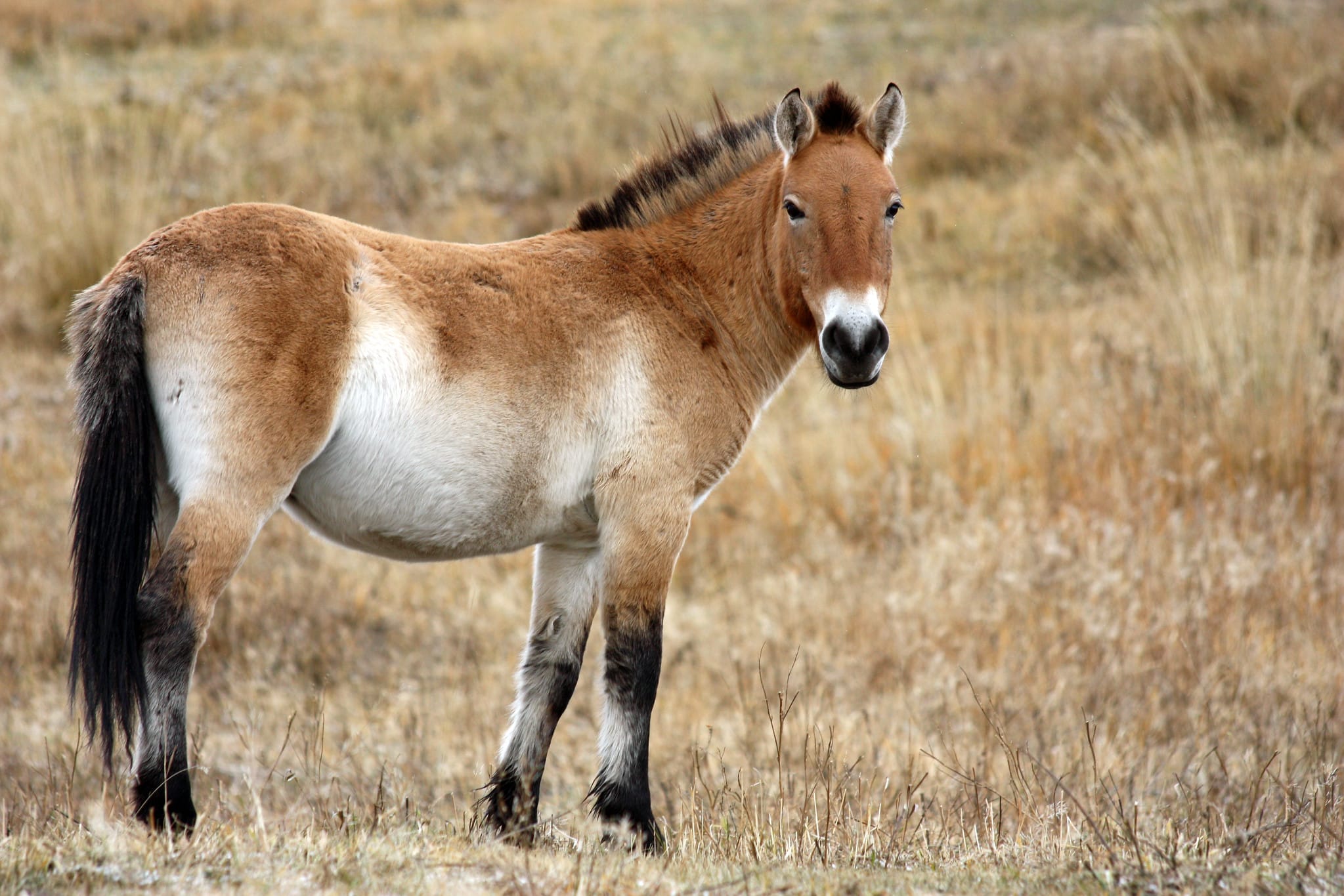
Wondering what went right this week in the conservation world? We’ve got you covered with our Conservation Optimism Round-Up! We are collating stories of optimism from around the globe so that you never miss your dose of weekly motivation. (Featured image credit: Przewalski’s Horse, Daniela Hartmann via Flickr)
1. Rewilding project aims to restore resilience to fire-prone Spain via wildlife
Since 2023, Rewilding Spain, part of the network Rewilding Europe, have worked to rewild the landscape of central Spain by introducing species to fill in the ecological role left empty by Europe’s lost biodiversity. In doing so, they hope to boost biodiversity in the region and mitigate large fires, building resilience against climate change and supporting the local economy.
They have reintroduced the world’s last truly wild horse species, the Przewalski’s horse to the landscape, totaling 35 horses in the project today. The conservationists have also brought in Taurus cattle, bred specifically to be as close to the extinct Aurochs that used to roam across most of the continent. Despite all of these animals being herbivores, each of them, combined with local deer, plays a unique role in the ecosystem, creating ecosystem heterogeneity and niches for greater diversity.
“Our initiative is long-term; we have funding committed for 20 years, but our goal is that, at some point, this becomes part of the normal landscape and can be maintained solely by the local people.” #rewilding #conservationoptimismhttps://t.co/28yc02NH9O
— Citizen Zoo (@CitizenZoo) September 3, 2025
2. Leopards and wild dogs are thriving in Zambia’s Kafue National Park
“Camera-trap images from a section of Kafue National Park in Zambia show conservation efforts are paying off: Populations of leopards, wild dogs and lions are all growing, Mongabay contributor Ryan Truscott reported in July.
By identifying each photographed leopard’s rosettes and whiskeres, conservationists have identified 95 individual leopard. In some parts of the study site, this means a population density of nine leopards per 100 square kilometers, which is considered among the highest for leopards in Southern Africa.
“African wild dog (Lycaon pictus) numbers in the area have also increased, from just one male and one female previously.” Trainee field ecologist Chisomo M’hango tells Mongabay, “They bred, and because obviously when their pups grew up and later dispersed into their own packs, we’re now monitoring three different packs.”
Camera-trap images from a section of Kafue National Park in Zambia show conservation efforts are paying off: Populations of leopards, wild dogs and lions are all growing.
— Mongabay (@mongabay.com) September 5, 2025 at 1:18 AM
[image or embed]
3. Lough Erne eel conservation work could help save endangered species
In Ireland, conservation work is being done for the critically endangered European eel. With commercial eel fishing being suspended on Lough Neagh, and a trap and transport scheme carried out in Lower Lough Erne. The trap and transport scheme employs some former eel fishermen in helping the eels avoid “danger posed by the hydropower stations within the Erne system” by catching them, then transporting them by road to be released into the sea.
“We now know that eels above 70cm in length are carrying in and around one million eggs, so that straightaway is a million-egg female going straight to sea,” said Dr Derek Evans, senior fisheries scientist from the Agri-Food and Biosciences Institute (AFBI).
Dr Evans also notes that eels still need more help to recover their populations. “The current advice from the International Council of the Exploration of the Sea says that, in regard to fishing opportunities, there is actually no fishing opportunity for eel.”
'Eels caught in Lower Lough Erne as part of a continuing trap and transport programme could be part of the species' salvation.' #rewilding #conservationoptimismhttps://t.co/QtYR1eNXjn
— Citizen Zoo (@CitizenZoo) September 4, 2025
4. Restoring the Páramo: How Ecuador healed its degraded high-Andean ecosystem
In this in-depth piece from Mongabay, learn more about how Ecuador “turn[ed] back the clock on centuries of degradation caused by livestock grazing.”
“The páramo, an ecosystem found in the Andes, had been heavily impacted by the draining of wetlands and soil compaction caused by centuries of livestock grazing. As the sheep were removed, the landscape began to heal: plant life regained a foothold, water quality improved, and species once driven out by the degradation, such as deer and foxes, returned.
“This could serve as a case study for how food chains rebuild and slowly reshape the landscape,” said Evelyn Araujo, a biologist with the Andean Condor Foundation.”
[FOUNDER'S BRIEF - @rhettayersbutler.bsky.social] Ecuador’s Antisana páramo, southeast of Quito, offers a striking example of ecological restoration, turning back the clock on centuries of degradation caused by livestock grazing.
— Mongabay (@mongabay.com) September 4, 2025 at 5:53 PM
[image or embed]
5. UK extends ban on burning peat
This week, the UK government has announced in a press release that they will extend the ban on burning peatlands.
“Peatlands improve water and air quality, create habitats for wildlife, absorb carbon and help protect communities from flooding. To deliver these benefits, they must be in a healthy condition but 80% of peatlands across England are dried out and deteriorating and actually emit carbon dioxide contributing to global warming.
Environment Minister Mary Creagh said in the press release, “Our peatlands are England’s Amazon Rainforest – home to our most precious wildlife, storing carbon and reducing flooding downstream. […] Restricting burning will help us restore and rewet peatlands. These new measures will create resilient peatlands that are naturally protected from wildfires.”
GOOD NEWS: the peat burning ban is being extended in the English uplands. 👏
— RSPB (@Natures_Voice) September 9, 2025
Peatlands lock up carbon, protect water & support rare wildlife.
We hope today's announcement signals a move to end this damaging practice for good, and thank our supporters for helping make it happen. pic.twitter.com/4JSdcdAUAB
6. Colorado voters show support for wolf reintroduction, 2 years after first release
An initative to halt the wolf reintroduction programme within the state of Colorado has failed to gather enough support to be placed on the 2026 ballot.
The Colorado Sun reports: “A coalition of ranchers, conservationists, hunters and community leaders opposes the initiative, saying it muddies the waters of negotiations it wants to make with Colorado Parks and Wildlife to continue reintroduction.” A recent poll also found that over half of Coloradoans still support the reintroduction, with 91% of 1,136 surveyed voters reporting that they feel informed about the programme.
An anti-wolf initiative in Colorado needed 125K signatures to reach the 2026 ballot—it got just 25K. Voters continue to speak loud & clear: Colorado’s wolf reintroduction stays. With 25 wolves already released & more coming, wolves are returning to the Front Range! pic.twitter.com/0qyyZLvND8
— Team Wolf (@teamwolf_org) September 8, 2025
7. Global solar installations up 64 percent so far this year
In good news for clean energy, Yale Environment 360 reports that “Even as the U.S. guts support for renewable power, the world is still pushing ahead on the shift to solar energy, with installations up 64 percent in the first half of this year.”
Solar is the fastest-growing source of electricity worldwide, and the buildout continues to gain pace, year after year. In the first six months of 2025, countries installed 380 gigawatts of solar capacity, up from 232 gigawatts in 2024, according to a new analysis from Ember, an energy think tank.
This year China has added twice as much solar capacity as the rest of the world combined, the analysis found, though the country is now at a crossroads. For the first time in China, solar isn’t just supplementing coal power, but replacing it.
It's the sun, stupid (borrowing from James Carville) #EarthOptimism #BeyondTheObituaries https://t.co/LmmXAc1rWx
— Dr. Nancy Knowlton (@SeaCitizens) September 4, 2025
Have a story to share for our weekly round-up? Use #ConservationOptimism on Twitter, Facebook, LinkedIn and Instagram!